Opening Corpus-based Measures of Morphological Productivity
Corpus-based Measures of Morphological Productivity
- Length
- 40 min
- Level
- Graduate
- Recorded
- University of Neuchâtel2020
Opening Corpus-based Measures of Morphological Productivity
Chapter 1 of 6: Introduction to morphological productivity
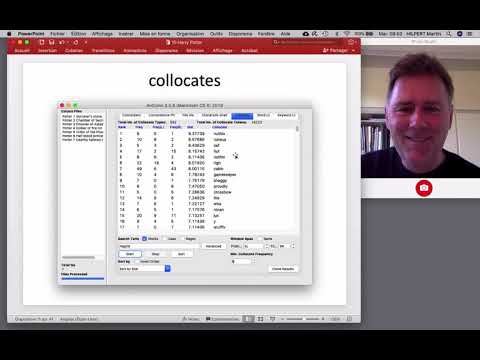
Corpus linguistics measures morphological productivity by comparing token frequency, type frequency, and hapax legomena across nominalization suffixes. The analysis uses AntConc to retrieve noun endings from the British National Corpus and Excel pivot tables to calculate statistics. Harald Baayen's metrics of potential productivity and expanding productivity evaluate how suffixes generate single-occurrence words. The session tests six suffixes, including -ness, -ation, and -ity, and demonstrates why potential productivity aligns with psycholinguistic findings better than raw token counts.
Your comment is kept while you sign up.Sign in
Calculates Harald Baayen's productivity measures for nominalization suffixes using corpus data.
Corpus linguistics measures morphological productivity by comparing token frequency, type frequency, and hapax legomena across nominalization suffixes. The analysis uses AntConc to retrieve noun endings from the British National Corpus and Excel pivot tables to calculate statistics. Harald Baayen's metrics of potential productivity and expanding productivity evaluate how suffixes generate single-occurrence words. The session tests six suffixes, including -ness, -ation, and -ity, and demonstrates why potential productivity aligns with psycholinguistic findings better than raw token counts.
This lecture
Lecture 7 of 9 of Corpus Linguistics.
Choose a node to see how it connects to this lecture. What comes before is on the leftat the top. What comes after is on the rightat the bottom. The ring is what it teaches. People and places are above. Other lectures and books are below.
Press a chosen node again to open it.