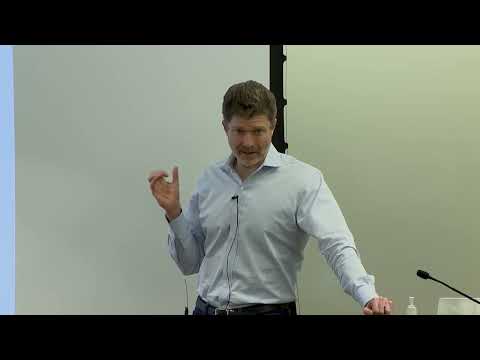
Opening Digital Photography: Lecture 6 (Stanford CS 178)
Digital Photography: Lecture 6 (Stanford CS 178)
- Length
- 1 h 16 min
- Level
- Undergraduate
- Recorded
- Stanford University2016
Opening Digital Photography: Lecture 6 (Stanford CS 178)
Chapter 1 of 11: Before the lecture
Contrasts phase-based autofocus via stereoscopic disparity with contrast autofocus climbing pixel gradients.
Autofocus and metering in digital cameras are the subject of session 6 of Levoy's Stanford course CS 178, recorded at Google in Spring 2016. Levoy starts with optical and electronic viewfinders, manual rangefinders that triangulate depth, and view cameras whose tilted lenses obey the Scheimpflug condition. Phase-based autofocus correlates views from different parts of the lens, while contrast-based autofocus maximizes local pixel gradients and risks hunting. Metering follows, through Ansel Adams's zone system and the 18 percent reflectance assumption that misjudges very bright or dark scenes. The session closes on exposure modes, linear raw files versus gamma-encoded JPEGs, and sensor limits, assuming basic geometrical optics and camera controls.
Autofocus and metering in digital cameras are the subject of session 6 of Levoy's Stanford course CS 178, recorded at Google in Spring 2016. Levoy starts with optical and electronic viewfinders, manual rangefinders that triangulate depth, and view cameras whose tilted lenses obey the Scheimpflug condition. Phase-based autofocus correlates views from different parts of the lens, while contrast-based autofocus maximizes local pixel gradients and risks hunting. Metering follows, through Ansel Adams's zone system and the 18 percent reflectance assumption that misjudges very bright or dark scenes. The session closes on exposure modes, linear raw files versus gamma-encoded JPEGs, and sensor limits, assuming basic geometrical optics and camera controls.
The Negative

This lecture
Lecture 6 of 18 of Lectures on Digital Photography.
Choose a node to see how it connects to this lecture. What comes before is on the leftat the top. What comes after is on the rightat the bottom. The ring is what it teaches. People and places are above.
Press a chosen node again to open it.
Your comment is kept while you sign up.Sign in