Opening Earth's Climate Evolution
Earth's Climate Evolution
- Length
- 1 h 6 min
- Level
- Undergraduate
- Recorded
- National Academy of Sciences2015
Opening Earth's Climate Evolution
Chapter 1 of 12: Before the lecture
Explains the Cenozoic 'Great Cooling' through falling carbon dioxide, drifting continents and orbital cycles.
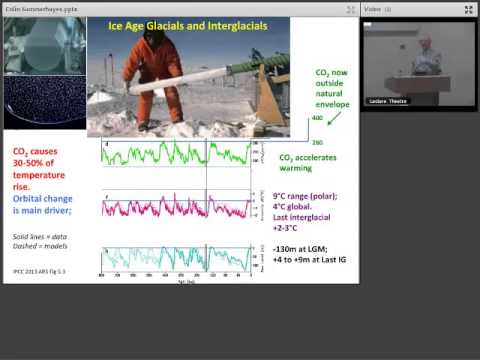
Earth's climate history emerges from geology, astronomy and atmospheric physics in this London Lecture by Colin Summerhayes of the University of Cambridge, given 15 April 2015. Summerhayes starts with Hutton's principle and the nineteenth-century dispute over erratic blocks, which Buckland, Lyell and Agassiz each explained differently. Wegener and Köppen's drifting-continent maps account for shifting climate zones, while orbital cycles from Croll to Milankovitch set the pacing of glacials. Oxygen isotope ratios in deep-sea foraminifera and gas bubbles in Antarctic ice cores show carbon dioxide and temperature changing together. The slow carbon cycle of volcanism, weathering and plate tectonics frames a final contrast with modern emissions, which push carbon dioxide far beyond interglacial levels.
Earth's climate history emerges from geology, astronomy and atmospheric physics in this London Lecture by Colin Summerhayes of the University of Cambridge, given 15 April 2015. Summerhayes starts with Hutton's principle and the nineteenth-century dispute over erratic blocks, which Buckland, Lyell and Agassiz each explained differently. Wegener and Köppen's drifting-continent maps account for shifting climate zones, while orbital cycles from Croll to Milankovitch set the pacing of glacials. Oxygen isotope ratios in deep-sea foraminifera and gas bubbles in Antarctic ice cores show carbon dioxide and temperature changing together. The slow carbon cycle of volcanism, weathering and plate tectonics frames a final contrast with modern emissions, which push carbon dioxide far beyond interglacial levels.
Theory of the Earth
Geological Society Statement on Climate Change
Principles of Geology
Climates of the Geological Past
IPCC 2013 AR5 Fig 5.3
Science 2013 paper by Parrenin et al.
The Phanerozoic Carbon Cycle: CO2 and O2
This lecture
Talk 11 of 24 of Climate Change & Paleoclimate Dynamics.
Choose a node to see how it connects to this lecture. What comes before is on the leftat the top. What comes after is on the rightat the bottom. The ring is what it teaches. People and places are above. Other lectures and books are below.
Press a chosen node again to open it.
Your comment is kept while you sign up.Sign in
Zachos et al 2008
Clette, Svalgaard, et al. Solar and Stellar Astrophysics (2014)
Steinhilber et al. PNAS 109 (16) (2013)
Wanner et al. JGSAL 2015
Earth's Climate Evolution (2013)
IPCC 2007
Sustainable Energy Without the Hot Air
IPCC report


