Opening Effective Potential and Boundary Conditions at r=0 (MIT 8.04 Quantum Physics I)
Effective Potential and Boundary Conditions at r=0 (MIT 8.04 Quantum Physics I)
- Length
- 14 min
- Level
- Undergraduate
- Recorded
- MIT2017
Opening Effective Potential and Boundary Conditions at r=0 (MIT 8.04 Quantum Physics I)
Chapter 1 of 3: Effective potential and radial wave equation
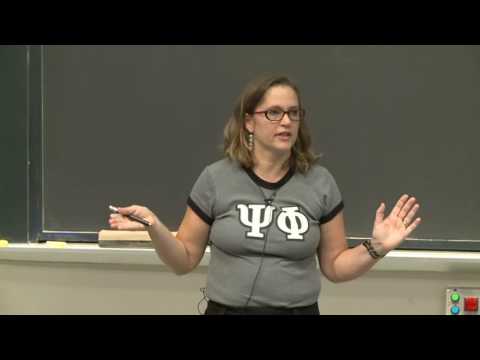
The radial Schrödinger equation for a central potential acquires a centrifugal barrier proportional to once angular momentum is included. Zwiebach, teaching the MIT course Quantum Physics I, combines this term with the central potential into an effective radial potential. He then reduces the normalization of the three-dimensional wave function to a one-dimensional integral of from zero to infinity. The radial function depends on and the energy but not on the magnetic quantum number . Analysis of the equation near rules out non-normalizable solutions and fixes the behaviour .

Your comment is kept while you sign up.Sign in
Zwiebach shows why the radial function must vanish as at the origin to stay normalizable.
The radial Schrödinger equation for a central potential acquires a centrifugal barrier proportional to once angular momentum is included. Zwiebach, teaching the MIT course Quantum Physics I, combines this term with the central potential into an effective radial potential. He then reduces the normalization of the three-dimensional wave function to a one-dimensional integral of from zero to infinity. The radial function depends on and the energy but not on the magnetic quantum number . Analysis of the equation near rules out non-normalizable solutions and fixes the behaviour .
This lecture
Lecture 77 of 88 of Quantum Physics I.
Choose a node to see how it connects to this lecture. What comes before is on the leftat the top. What comes after is on the rightat the bottom. The ring is what it teaches. People and places are above. Other lectures and books are below.
Press a chosen node again to open it.