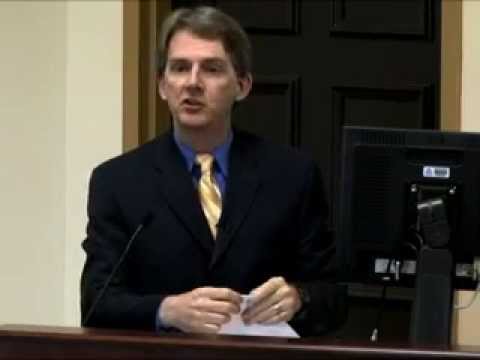
Opening Evidence Law: Admissions and Confessions (CQUniversity LAWS13010)
Evidence Law: Admissions and Confessions (CQUniversity LAWS13010)
- Length
- 49 min
- Level
- Undergraduate
- Recorded
- CQUniversity2014
Opening Evidence Law: Admissions and Confessions (CQUniversity LAWS13010)
Chapter 1 of 7: Before the lecture
Marinac contrasts civil admissions by words, conduct or silence with the voluntariness rule for confessions.
Evidence Law distinguishes between civil admissions and criminal confessions as key exceptions to the hearsay rule. Admissions in civil matters require statements contrary to a party's legal interests, which may be expressed through words, conduct, or silence. Criminal confessions demand much stricter procedural safeguards, including absolute voluntarism and adherence to statutory police interview rules. Marinac examines cases such as Slatterie and Pooley, Rumping v DPP, and Swafield and Pavic to illustrate these evidentiary principles. Judicial discretion ultimately guards against unfairness and prejudice when evaluating whether such statements are admissible in court.
Evidence Law distinguishes between civil admissions and criminal confessions as key exceptions to the hearsay rule. Admissions in civil matters require statements contrary to a party's legal interests, which may be expressed through words, conduct, or silence. Criminal confessions demand much stricter procedural safeguards, including absolute voluntarism and adherence to statutory police interview rules. Marinac examines cases such as Slatterie and Pooley, Rumping v DPP, and Swafield and Pavic to illustrate these evidentiary principles. Judicial discretion ultimately guards against unfairness and prejudice when evaluating whether such statements are admissible in court.
Slatterie v Pooley
Evidence Act 1995 (Cth)
McKay v R
Rumping v DPP [1964] AC 814
Loumbos v McCoy [1986] Unrep, FCNSWCA
Hurst v Evans [1917] 1 KB 352
This lecture
Lecture 8 of 11 of Evidence Law.
Choose a node to see how it connects to this lecture. What comes before is on the leftat the top. What comes after is on the rightat the bottom. The ring is what it teaches. People and places are above. Other lectures and books are below.
Press a chosen node again to open it.
Your comment is kept while you sign up.Sign in
Civil Liability Act 2003 (Qld) s.72D
Singh v DPP [2006] NSWCA 333
Singh v DPP
Young v Tibbits
Thatcher v Charles
R v Fairey
Nowell v Palmer
Smith v Joyce (1954) 89 CLR 529
Fraser Henleins v Cody (1945) 70 CLR 100
McKay v R (1935) 54 CLR 1
Criminal Law Amendment Act 1894 (Qld) s.10
Police Powers and Responsibilities Act 2000 (Qld) s.416
Cleland v R (1982) 151 CLR 1
R v Small (No. 2) (2009) QDC 320
R v Petty & Maiden (1991) 173 CLR 95
Police Powers and Responsibilities Act 2000 (Qld) s.397
Tripodi v The Queen (1961) 104 CLR 1
Ahern v The Queen (1988) 165 CLR 87
R v Swaffield; Pavic v The Queen [1998] 192 CLR 159
Police Powers and Responsibilities Act 2000
Police Powers and Responsibilities Regulation 2000