Opening Group Velocity and Stationary Phase Approximation (MIT 8.04 Quantum Physics I)
Group Velocity and Stationary Phase Approximation (MIT 8.04 Quantum Physics I)
- Length
- 11 min
- Level
- Undergraduate
- Recorded
- MIT2017
Opening Group Velocity and Stationary Phase Approximation (MIT 8.04 Quantum Physics I)
Chapter 1 of 3: Dispersion relations and wave packets
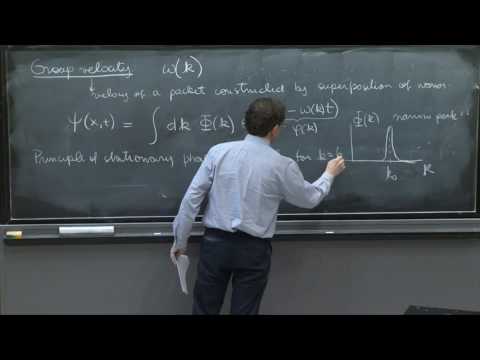
Group velocity governs how a quantum wave packet built from superposed plane waves moves through space. Zwiebach starts from a dispersion relation and writes the packet as an integral of exponentials weighted by an amplitude function peaked at a central wave number. Rapid oscillations in the integrand cancel the integral almost everywhere, except where the phase is stationary in . Setting the derivative of the phase to zero locates the packet's peak and shows that it moves at evaluated at the central wave number. The derivation, from session 14 of MIT 8.04, assumes basic calculus and familiarity with complex exponentials.

Your comment is kept while you sign up.Sign in
Zwiebach finds the peak of a wave packet by demanding stationary phase, yielding at the central wave number.
Group velocity governs how a quantum wave packet built from superposed plane waves moves through space. Zwiebach starts from a dispersion relation and writes the packet as an integral of exponentials weighted by an amplitude function peaked at a central wave number. Rapid oscillations in the integrand cancel the integral almost everywhere, except where the phase is stationary in . Setting the derivative of the phase to zero locates the packet's peak and shows that it moves at evaluated at the central wave number. The derivation, from session 14 of MIT 8.04, assumes basic calculus and familiarity with complex exponentials.
This lecture
Lecture 14 of 88 of Quantum Physics I.
Choose a node to see how it connects to this lecture. What comes before is on the leftat the top. What comes after is on the rightat the bottom. The ring is what it teaches. People and places are above. Other lectures and books are below.
Press a chosen node again to open it.