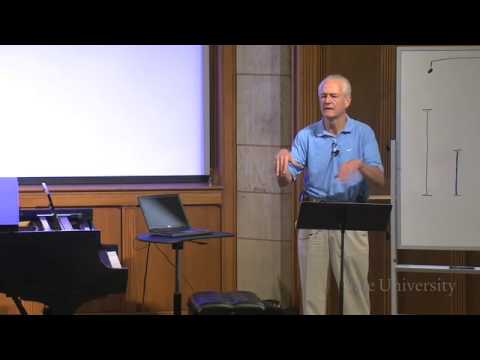
Opening Introduction to Instruments and Musical Genres
Introduction to Instruments and Musical Genres
- Length
- 47 min
- Level
- Introductory
- Recorded
- Yale University2012
Opening Introduction to Instruments and Musical Genres
Chapter 1 of 7: Musical lexicon of songs versus pieces
Orchestral genres, instruments and basic acoustics form the subject of Craig Wright's second session of Listening to Music at Yale. Wright starts with vocabulary, insisting that instrumental works are pieces, not songs, and separates motive from theme. Excerpts from Beethoven and Tchaikovsky contrast the four-movement symphony with the concerto, where a soloist confronts the orchestra. Guest players demonstrate the French horn's harmonic series, the bassoon's double reed, and viola techniques such as vibrato, pizzicato and tremolo. Mussorgsky's Polish Oxcart and Strauss's Death and Transfiguration then show low frequencies, overtone recipes and dissonance resolving to consonance.
Your comment is kept while you sign up.Sign in
Live horn, bassoon and viola demonstrations show how overtones set timbre, then Strauss resolves dissonance.
Orchestral genres, instruments and basic acoustics form the subject of Craig Wright's second session of Listening to Music at Yale. Wright starts with vocabulary, insisting that instrumental works are pieces, not songs, and separates motive from theme. Excerpts from Beethoven and Tchaikovsky contrast the four-movement symphony with the concerto, where a soloist confronts the orchestra. Guest players demonstrate the French horn's harmonic series, the bassoon's double reed, and viola techniques such as vibrato, pizzicato and tremolo. Mussorgsky's Polish Oxcart and Strauss's Death and Transfiguration then show low frequencies, overtone recipes and dissonance resolving to consonance.
This lecture
Lecture 2 of 23 of Listening to Music.
Choose a node to see how it connects to this lecture. What comes before is on the leftat the top. What comes after is on the rightat the bottom. The ring is what it teaches. People and places are above. Other lectures and books are below.
Press a chosen node again to open it.


