
Opening Inverse Differentiation
Inverse Differentiation
- Length
- 43 min
- Level
- Undergraduate
- Recorded
- MIT2011
Opening Inverse Differentiation
Chapter 1 of 6: Before the lecture
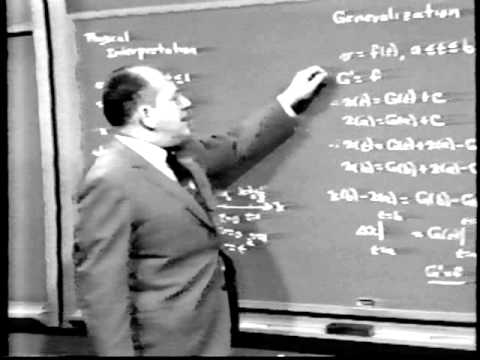
Gross runs the D-machine in reverse and uses the mean value theorem to show antiderivatives differ by a constant.
Inverse differentiation asks for every function whose derivative equals a given function, and Herbert Gross treats it as running the D-machine backward. Because constants have derivative zero, the machine is not one-to-one. Circle diagrams and the corollary to the mean value theorem show that antiderivatives form families differing by a constant. Gross derives the power rule and linearity for indefinite integrals, connects them to the notation , and works the inverse chain rule by spotting the inner derivative factor. The session, from MIT's Calculus Revisited series, closes with differentials, using separation of variables to recover a circle from its slope.
Inverse differentiation asks for every function whose derivative equals a given function, and Herbert Gross treats it as running the D-machine backward. Because constants have derivative zero, the machine is not one-to-one. Circle diagrams and the corollary to the mean value theorem show that antiderivatives form families differing by a constant. Gross derives the power rule and linearity for indefinite integrals, connects them to the notation , and works the inverse chain rule by spotting the inner derivative factor. The session, from MIT's Calculus Revisited series, closes with differentials, using separation of variables to recover a circle from its slope.
This lecture
Lecture 17 of 38 of MIT Calculus Revisited: Single Variable Calculus.
Choose a node to see how it connects to this lecture. What comes before is on the leftat the top. What comes after is on the rightat the bottom. The ring is what it teaches. People and places are above.
Press a chosen node again to open it.
Your comment is kept while you sign up.Sign in


