Opening Linear Algebra: The Dimension of a Subspace
Linear Algebra: The Dimension of a Subspace
- Length
- 53 min
- Level
- Undergraduate
Opening Linear Algebra: The Dimension of a Subspace
Chapter 1 of 8: Basis for kernel and image
Proves the rank-nullity theorem and uses it to show no non-square matrix has both a left and a right inverse.
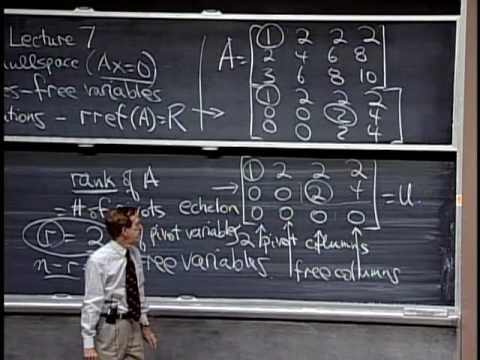
The dimension of a subspace is the number of vectors in any of its bases, and Hower builds the theory from that definition. Her session opens by finding bases for the kernel and image of a matrix from its reduced row echelon form. She then bounds dimension by the sizes of spanning and linearly independent sets, and checks that four given vectors form a basis of . The rank-nullity theorem follows, applied to possible kernel and image sizes and to left inverses of non-square matrices. The course assumes Gaussian elimination, span and linear independence, and closes by extending the list of equivalent conditions for invertibility.
The dimension of a subspace is the number of vectors in any of its bases, and Hower builds the theory from that definition. Her session opens by finding bases for the kernel and image of a matrix from its reduced row echelon form. She then bounds dimension by the sizes of spanning and linearly independent sets, and checks that four given vectors form a basis of . The rank-nullity theorem follows, applied to possible kernel and image sizes and to left inverses of non-square matrices. The course assumes Gaussian elimination, span and linear independence, and closes by extending the list of equivalent conditions for invertibility.
Chapter 3 (Summary 3.3.10)
This lecture
Lecture 10 of 24 of Linear Algebra: Systems, Matrices & Transformations.
Choose a node to see how it connects to this lecture. What comes before is on the leftat the top. What comes after is on the rightat the bottom. The ring is what it teaches. People and places are above.
Press a chosen node again to open it.
Your comment is kept while you sign up.Sign in