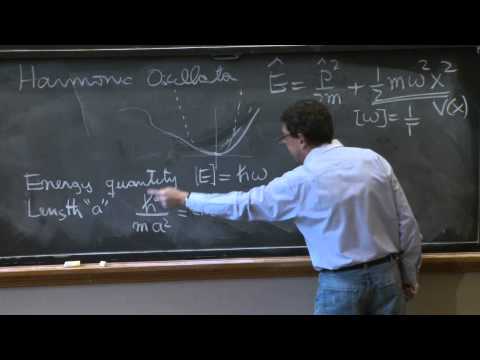
Opening Nondegeneracy of Bound States in One Dimension and Real Wavefunctions
Nondegeneracy of Bound States in One Dimension and Real Wavefunctions
- Length
- 13 min
- Level
- Undergraduate
- Recorded
- MIT2017
Opening Nondegeneracy of Bound States in One Dimension and Real Wavefunctions
Chapter 1 of 3: Qualitative insights into wave functions
Bound states of one-dimensional potentials on the full real line are never degenerate, and their wavefunctions can always be taken real. Zwiebach opens session 40 of MIT's Quantum Physics I with qualitative properties that help picture one-dimensional wavefunctions. He then states the nondegeneracy theorem for normalizable bound states. For a real potential, the complex conjugate of a solution of the time-independent Schrödinger equation solves it with the same energy, so its real and imaginary parts are solutions too. Because a bound-state energy admits only one solution, any bound state is a real function times a constant phase. The short session assumes stationary states, energy eigenstates and normalization.

Your comment is kept while you sign up.Sign in
Combines complex conjugation with nondegeneracy to show that one-dimensional bound states are real up to a phase.
Bound states of one-dimensional potentials on the full real line are never degenerate, and their wavefunctions can always be taken real. Zwiebach opens session 40 of MIT's Quantum Physics I with qualitative properties that help picture one-dimensional wavefunctions. He then states the nondegeneracy theorem for normalizable bound states. For a real potential, the complex conjugate of a solution of the time-independent Schrödinger equation solves it with the same energy, so its real and imaginary parts are solutions too. Because a bound-state energy admits only one solution, any bound state is a real function times a constant phase. The short session assumes stationary states, energy eigenstates and normalization.
This lecture
Lecture 40 of 88 of Quantum Physics I.
Choose a node to see how it connects to this lecture. What comes before is on the leftat the top. What comes after is on the rightat the bottom. The ring is what it teaches. People and places are above. Other lectures and books are below.
Press a chosen node again to open it.