Opening Partial Derivatives: The Chain Rule
Partial Derivatives: The Chain Rule
- Length
- 39 min
- Level
- Undergraduate
- Recorded
- MIT2012
Opening Partial Derivatives: The Chain Rule
Chapter 1 of 6: Before the lecture
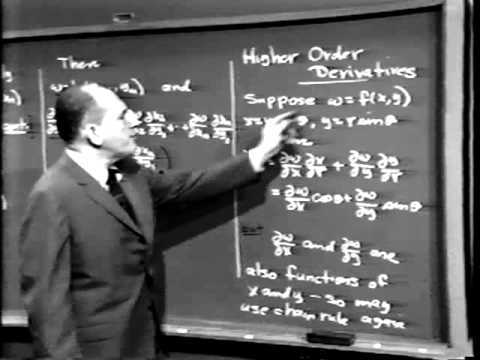
The multivariable chain rule computes partial derivatives of a composite function by summing products of intermediate partial rates. In Part III, Lecture 4 of MIT's Calculus Revisited, Herbert Gross treats a function of three variables, each depending on two parameters. He proves the rule from linear approximations, using continuous differentiability to make the error terms vanish in the limit. A quadratic example compares direct substitution with the chain rule, and Gross then writes the general case of intermediate variables in sigma notation. He closes by applying the rule repeatedly to obtain second-order mixed partial derivatives in polar coordinates. The material assumes single-variable calculus, basic partial differentiation and familiarity with polar coordinates.

Your comment is kept while you sign up.Sign in
Proves the multivariable chain rule by linear approximation, then finds a mixed second partial in polar coordinates.
The multivariable chain rule computes partial derivatives of a composite function by summing products of intermediate partial rates. In Part III, Lecture 4 of MIT's Calculus Revisited, Herbert Gross treats a function of three variables, each depending on two parameters. He proves the rule from linear approximations, using continuous differentiability to make the error terms vanish in the limit. A quadratic example compares direct substitution with the chain rule, and Gross then writes the general case of intermediate variables in sigma notation. He closes by applying the rule repeatedly to obtain second-order mixed partial derivatives in polar coordinates. The material assumes single-variable calculus, basic partial differentiation and familiarity with polar coordinates.
Calculus text
This lecture
Lecture 15 of 27 of MIT Calculus Revisited: Multivariable & Vector Calculus.
Choose a node to see how it connects to this lecture. What comes before is on the leftat the top. What comes after is on the rightat the bottom. The ring is what it teaches. People and places are above. Other lectures and books are below.
Press a chosen node again to open it.