Opening Polynomial Approximations
Polynomial Approximations
- Length
- 33 min
- Level
- Undergraduate
- Recorded
- MIT2011
Opening Polynomial Approximations
Chapter 1 of 5: Before the lecture
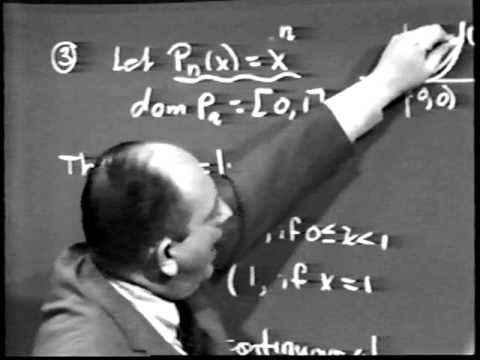
Polynomial approximations replace a smooth function near a point with a polynomial that matches its value and its first derivatives there. Gross derives the coefficients, showing that the -th coefficient equals the -th derivative at zero divided by factorial. He then poses three questions: whether the sequence of polynomials converges, whether its limit equals the function, and whether the limit keeps the function's properties. Counterexamples show each can fail. The ratio test, absolute convergence and the radius of convergence follow, and Taylor's theorem with an integral remainder, obtained through integration by parts, bounds the error.
Your comment is kept while you sign up.Sign in
Derives Taylor coefficients from matching derivatives, then shows by counterexample why convergence must be proved.
Polynomial approximations replace a smooth function near a point with a polynomial that matches its value and its first derivatives there. Gross derives the coefficients, showing that the -th coefficient equals the -th derivative at zero divided by factorial. He then poses three questions: whether the sequence of polynomials converges, whether its limit equals the function, and whether the limit keeps the function's properties. Counterexamples show each can fail. The ratio test, absolute convergence and the radius of convergence follow, and Taylor's theorem with an integral remainder, obtained through integration by parts, bounds the error.
This lecture
Lecture 36 of 38 of MIT Calculus Revisited: Single Variable Calculus.
Choose a node to see how it connects to this lecture. What comes before is on the leftat the top. What comes after is on the rightat the bottom. The ring is what it teaches. People and places are above.
Press a chosen node again to open it.


