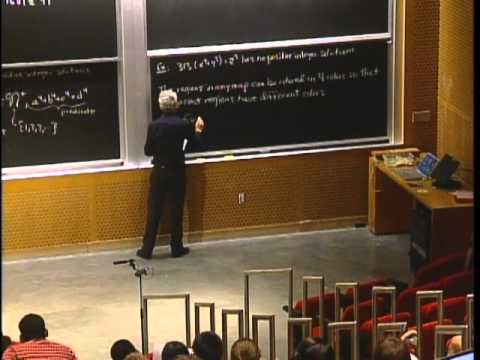
Opening Quantum Computing Overview
Quantum Computing Overview
- Length
- 15 min
- Level
- Graduate
- Recorded
- Carnegie Mellon University2020
Opening Quantum Computing Overview
Chapter 1 of 3: Randomized computation and algorithmic speedups
Introduces quantum computing through sampling from the Fourier transform of implicitly-represented data.
Quantum computing fundamentals begin by adding quantum particles to standard computation. The lecture details how an exponential amount of data, represented implicitly by an efficient classical algorithm, transforms using a physical quantum apparatus. It surveys speedups, specifically Shor's factoring algorithm and Grover's search algorithm for the satisfiability problem. The presentation concludes by explaining how quantum computers apply a Fourier transform to a state and yield a string with probability proportional to the squared magnitude of its coefficient.
Quantum computing fundamentals begin by adding quantum particles to standard computation. The lecture details how an exponential amount of data, represented implicitly by an efficient classical algorithm, transforms using a physical quantum apparatus. It surveys speedups, specifically Shor's factoring algorithm and Grover's search algorithm for the satisfiability problem. The presentation concludes by explaining how quantum computers apply a Fourier transform to a state and yield a string with probability proportional to the squared magnitude of its coefficient.
Quantum Computation and Quantum Information
Quantum Computer Science
Algorithms for quantum computation: discrete logarithms and factoring
This lecture
Lecture 24 of 89 of A Theorist's Toolkit.
Choose a node to see how it connects to this lecture. What comes before is on the leftat the top. What comes after is on the rightat the bottom. The ring is what it teaches. People and places are above. Other lectures and books are below.
Press a chosen node again to open it.
Your comment is kept while you sign up.Sign in
A fast quantum mechanical algorithm for database search