Opening Scattering States and the Step Potential (MIT 8.04 Quantum Physics I)
Scattering States and the Step Potential (MIT 8.04 Quantum Physics I)
- Length
- 11 min
- Level
- Undergraduate
- Recorded
- MIT2017
Opening Scattering States and the Step Potential (MIT 8.04 Quantum Physics I)
Chapter 1 of 3: Properties of scattering states
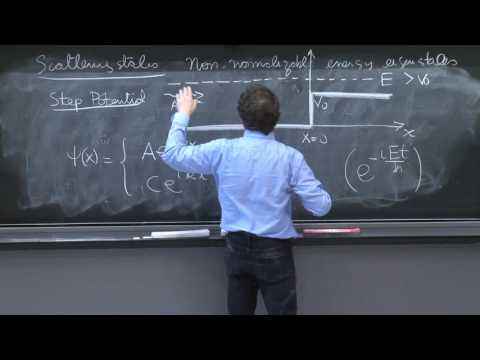
Scattering states of the quantum step potential are energy eigenstates that cannot be normalized, so physical particles are built as wave packets of them. Zwiebach sets the potential to zero for and to a constant for , then takes energies above the step. On each side he writes a solution of the time-independent Schrödinger equation, with wave numbers and . Continuity of the wave function and its derivative at the origin produces two linear equations. Solving them expresses the reflected and transmitted amplitudes as ratios fixed by and . The eleven-minute MIT 8.04 session assumes the Schrödinger equation and complex exponentials.

Your comment is kept while you sign up.Sign in
Zwiebach matches wave function and slope at a potential step, fixing reflected and transmitted amplitudes.
Scattering states of the quantum step potential are energy eigenstates that cannot be normalized, so physical particles are built as wave packets of them. Zwiebach sets the potential to zero for and to a constant for , then takes energies above the step. On each side he writes a solution of the time-independent Schrödinger equation, with wave numbers and . Continuity of the wave function and its derivative at the origin produces two linear equations. Solving them expresses the reflected and transmitted amplitudes as ratios fixed by and . The eleven-minute MIT 8.04 session assumes the Schrödinger equation and complex exponentials.
This lecture
Lecture 56 of 88 of Quantum Physics I.
Choose a node to see how it connects to this lecture. What comes before is on the leftat the top. What comes after is on the rightat the bottom. The ring is what it teaches. People and places are above. Other lectures and books are below.
Press a chosen node again to open it.


