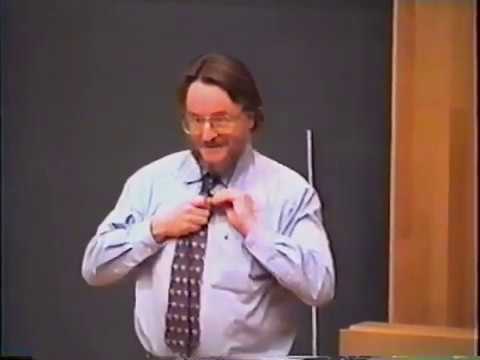
Opening Tangles, Bangles and Knots with John Conway
Tangles, Bangles and Knots with John Conway
- Length
- 1 h 15 min
- Level
- Graduate
- Recorded
- Princeton Universityat Harvard University2020
Opening Tangles, Bangles and Knots with John Conway
Chapter 1 of 9: Before the lecture
Conway proves the trefoil cannot be untied using mod-3 labelings, then turns rope tangles into fractions.
Knot theory classifies closed curves in three-dimensional space that cannot be deformed into a plain circle without passing through themselves. Conway, at Harvard, proves that knots exist by counting the mod-3 arithmetic labelings of a diagram. That count survives every Reidemeister move, so the trefoil can never become the unknot. Volunteers then twist and turn ropes to show that rational tangles correspond to fractions through continued fractions, with Richard Borcherds choosing one fraction. Rational bangles, arithmetical tangles and Thurston's geometric classes follow, and a final string demonstration shows a slice knot bounding a surface in four-dimensional space.
Knot theory classifies closed curves in three-dimensional space that cannot be deformed into a plain circle without passing through themselves. Conway, at Harvard, proves that knots exist by counting the mod-3 arithmetic labelings of a diagram. That count survives every Reidemeister move, so the trefoil can never become the unknot. Volunteers then twist and turn ropes to show that rational tangles correspond to fractions through continued fractions, with Richard Borcherds choosing one fraction. Rational bangles, arithmetical tangles and Thurston's geometric classes follow, and a final string demonstration shows a slice knot bounding a surface in four-dimensional space.

This lecture
Lecture 26 of 27 of Quantum Field Theory.
Choose a node to see how it connects to this lecture. What comes before is on the leftat the top. What comes after is on the rightat the bottom. The ring is what it teaches. People and places are above.
Press a chosen node again to open it.
Your comment is kept while you sign up.Sign in


