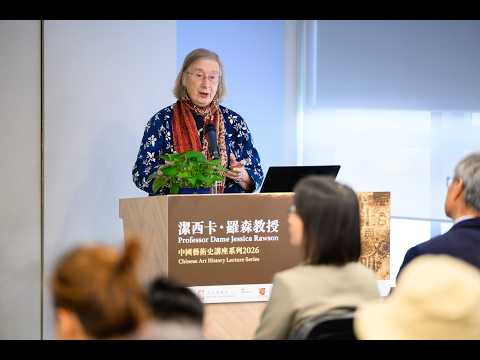
Opening The Dancing Horses of the Tang Dynasty (618–906) and their Predecessors
The Dancing Horses of the Tang Dynasty (618–906) and their Predecessors
- Length
- 59 min
- Level
- Graduate
- Recorded
- The Chinese University of Hong Kong2026
Opening The Dancing Horses of the Tang Dynasty (618–906) and their Predecessors
Chapter 1 of 9: Before the lecture
Tang dynasty dancing horses, performing for Emperor Xuanzong, stand at the end of a long tradition of horses imported from Central Asia. Jessica Rawson argues that Chinese courts obtained them through a gift economy trading silk for horses. Her account forms the third session of the Chinese University of Hong Kong series on the loess and China. She shows why loess farming and mineral-poor pastures made raising free-roaming horses in China so difficult. Burial evidence contrasts whole chariot deposits in China with horse-head offerings on the steppe. The argument runs from Qin cavalry gear and Han depots in the Hexi corridor to Song and Yuan dealings with northern riders.

Your comment is kept while you sign up.Sign in
Rawson sets Xuanzong's dancing horses against centuries of silk-for-horse gifting between Chinese courts and the steppe.
Tang dynasty dancing horses, performing for Emperor Xuanzong, stand at the end of a long tradition of horses imported from Central Asia. Jessica Rawson argues that Chinese courts obtained them through a gift economy trading silk for horses. Her account forms the third session of the Chinese University of Hong Kong series on the loess and China. She shows why loess farming and mineral-poor pastures made raising free-roaming horses in China so difficult. Burial evidence contrasts whole chariot deposits in China with horse-head offerings on the steppe. The argument runs from Qin cavalry gear and Han depots in the Hexi corridor to Song and Yuan dealings with northern riders.
The Dancing Horses of the Tang
The King's Road, Diplomacy and the Remaking of the King's Road
The King's Road
Ingestion and Food Technologies: Maintaining Differences Over the Long-term in West, South and East Asia
Sui-Tang China and Its Turko-Mongol Neighbours
Research published in Nature
'Steppe' style in southeast Gansu province (China) in the 4th and 3rd centuries BC
Art, historical and archaeometric analyses of 'animal style' gold and silver ornaments (4th-3rd century BCE) found in northwest China
Taking out the Grand Carriage, Imperial Spectacle and Visual Culture of Northern Song Kaifeng
Shahnama
This lecture
Lecture 3 of 3 of Chinese Art History Lecture Series: The Loess and China.
Choose a node to see how it connects to this lecture. What comes before is on the leftat the top. The ring is what it teaches. People and places are above. Other lectures and books are below.
Press a chosen node again to open it.


