Opening Waves on the Finite Square Well (MIT 8.04 Quantum Physics I)
Waves on the Finite Square Well (MIT 8.04 Quantum Physics I)
- Length
- 16 min
- Level
- Undergraduate
- Recorded
- MIT2017
Opening Waves on the Finite Square Well (MIT 8.04 Quantum Physics I)
Chapter 1 of 4: Before the lecture
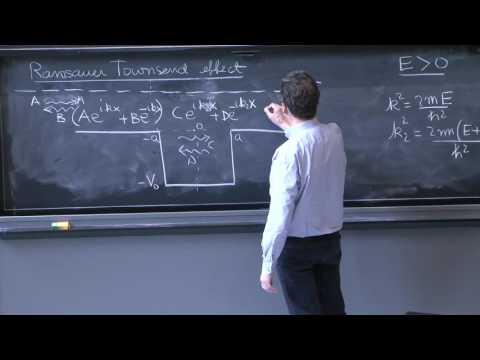
Scattering off the finite square well shows that a quantum particle can reflect where the potential drops and its kinetic energy rises. Zwiebach recalls earlier work on scattering states and wave packet time delays, then names the target: resonant transmission and the Ramsauer-Townsend effect. He writes the energy eigenstate as plane waves in three regions. Continuity of the wave function and its derivative at both edges gives four equations for the coefficients. Reflection and transmission coefficients follow from probability currents, whose conservation makes them sum to one, while the eigenstate's overall normalization stays undetermined.

Your comment is kept while you sign up.Sign in
Matches plane waves across three regions of a finite square well to show reflection where the potential drops.
Scattering off the finite square well shows that a quantum particle can reflect where the potential drops and its kinetic energy rises. Zwiebach recalls earlier work on scattering states and wave packet time delays, then names the target: resonant transmission and the Ramsauer-Townsend effect. He writes the energy eigenstate as plane waves in three regions. Continuity of the wave function and its derivative at both edges gives four equations for the coefficients. Reflection and transmission coefficients follow from probability currents, whose conservation makes them sum to one, while the eigenstate's overall normalization stays undetermined.
This lecture
Lecture 60 of 88 of Quantum Physics I.
Choose a node to see how it connects to this lecture. What comes before is on the leftat the top. What comes after is on the rightat the bottom. The ring is what it teaches. People and places are above. Other lectures and books are below.
Press a chosen node again to open it.


