
Justice
Prof. Michael SandelMichael Sandel's landmark moral and political philosophy course examining Bentham, Mill, Nozick, Locke, Kant, Rawls, and Aristotle through live Socratic courtroom and policy dilemmas.
Syllabus
13Justice: The Moral Side of Murder & Cannibalism
Live Socratic moral philosophy at its sharpest: Sandel extracts conflicting consequentialist and Kantian intuitions directly from student debate before naming a single philosopher.
Harvard Justice #02: Putting a Price Tag on Life — Cost-Benefit Analysis & John Stuart Mill
Tests Bentham's utilitarian calculus against real corporate cost-benefit memos (Ford Pinto, Philip Morris) and Mill's distinction between higher and lower pleasures.
Harvard Justice #03: Free to Choose — Robert Nozick, Self-Ownership & The Minimal State
Examines Robert Nozick's Anarchy, State, and Utopia: if you own yourself, is redistributive taxation morally indistinguishable from forced labor?
Harvard Justice #04: This Land Is My Land — John Locke on Natural Rights, Labor & Consent
Reads Locke's Second Treatise critically: how mixing labor creates private property before government, the Lockean proviso, and tacit consent.
Justice: What's The Right Thing To Do? Episode 05: "HIRED GUNS"
Professor Michael Sandel examines the ethical implications of market mechanisms in allocating civic duties, using historical conscription policies and contemporary surrogacy contracts as case studies. The lecture delves into utilitarian and libertarian perspectives on obligations of citizenship and the commodification of human life.
Harvard Justice #06: Mind Your Motive — Immanuel Kant's Groundwork & Categorical Imperative
One of the clearest introductions to Kantian ethics ever filmed: autonomy vs. heteronomy, acting from duty vs. inclination, and treating humanity never merely as a means.
Justice: What's The Right Thing To Do? Episode 07: "A LESSON IN LYING"
Professor Michael Sandel examines Immanuel Kant's stringent moral theory regarding lying, contrasting it with the ethics of misleading truths. The lecture then introduces John Rawls's theory of justice as fairness, exploring the hypothetical social contract and the 'veil of ignorance' as mechanisms for establishing equitable principles.
Justice: What's The Right Thing To Do? Episode 08: "WHATS A FAIR START?"
This lecture systematically examines John Rawls's theory of distributive justice, particularly his argument that natural talents and social circumstances are 'morally arbitrary' and thus cannot justify radical inequalities. Professor Sandel explores Rawls's veil of ignorance thought experiment and its implications for establishing principles of a fair societal start.
Lecture 9: Arguing Affirmative Action (ER22)
This lecture examines affirmative action through the 1996 Cheryl Hopwood court case, debating whether race should be considered to correct educational inequalities or compensate for historical injustices. Students discuss the ethical merits and challenges of such policies.
Lecture 10: The Good Citizen (ER22)
This lecture explores Aristotle's teleological view that politics cultivates virtue, illustrating how the purpose (telos) of a community informs who deserves reward. The Casey Martin golf cart case further probes how we discern a practice's essential purpose.
Lecture 11: The Claims of Community (ER22)
This session contrasts Kant's emphasis on individual freedom and universal duties with communitarian philosophy, which posits obligations of membership, solidarity, and loyalty not solely based on consent. It discusses inherited identities and unchosen responsibilities.
Lecture 12: Debating Same-Sex Marriage (ER22)
This lecture navigates the complex relationship between justice principles and varying conceptions of the good life, focusing on the debate over same-sex marriage. It questions whether reasoning about the good is essential for determining rights.
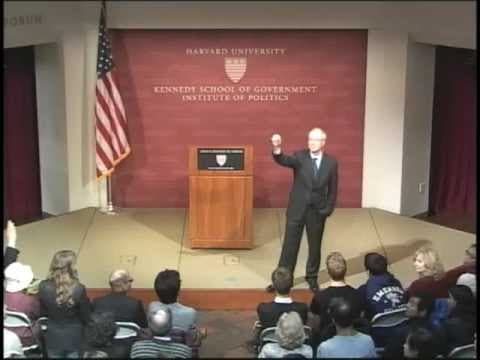
The Public Philosopher: Healthcare, Welfare, and the American Dream (ER22)
Michael Sandel leads a public debate examining the ethical dimensions of healthcare policy and social welfare, interrogating the philosophical underpinnings of the American Dream within a framework of distributive justice.