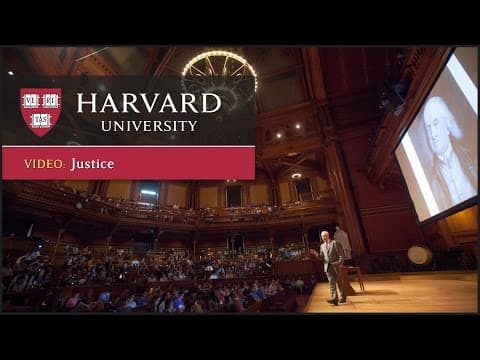

Justice
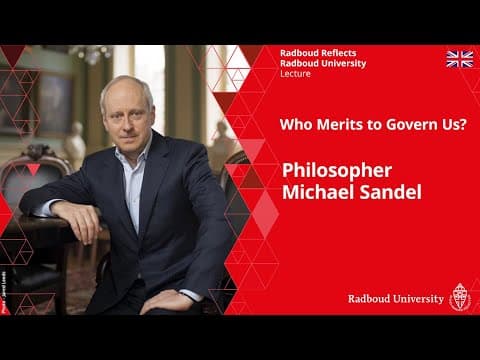
Michael Sandel's landmark moral and political philosophy course examining Bentham, Mill, Nozick, Locke, Kant, Rawls, and Aristotle through live Socratic courtroom and policy dilemmas.
Moral and political philosophy, epistemology, metaphysics, philosophy of mind, logic, and philosophy of science.
Complete university lecture courses in philosophy & ethics.
Michael Sandel's landmark moral and political philosophy course examining Bentham, Mill, Nozick, Locke, Kant, Rawls, and Aristotle through live Socratic courtroom and policy dilemmas.
Rigorous analytic metaphysics and moral philosophy examining personal identity, mind-body dualism vs. physicalism, Plato's Phaedo, immortality, and whether being dead can harm a person.
Pairs Plato, Aristotle, Epictetus, Hobbes, Kant, and Mill with contemporary cognitive science, behavioral economics, and moral psychology on flourishing, habit, and justice.
Celebrated lecture series examining Nietzsche, Freud, Marx, Heidegger, Sartre, Wittgenstein, Habermas, Foucault, Derrida, and Baudrillard on modernity and human agency.
Close philosophical reading of foundational political texts on regime, sovereignty, liberty, and citizenship: Plato's Republic, Aristotle's Politics, Machiavelli, Hobbes, Locke, Rousseau, and Tocqueville.
Morphology, phonetics, phonology, generative syntax, compositional semantics, pragmatics, historical language change, and universal structural constraints across human languages.
Two complementary philosophy talks paired around a central intellectual tension.
How universal syntactic rules and active free-energy minimization offer two distinct mathematical lenses on human cognition.
Self-contained lectures, Nobel addresses, and research colloquia you can watch in one sitting.
Richard Feynman's final Messenger Lecture, reflecting on the scientific process itself—the interplay between theoretical models, empirical predictions, and the role of observation in validating knowledge.
The fourteenth installment of the 'Purposes of College Education' series, exploring the evolution and concepts of democracy from ancient origins to modern interpretations.
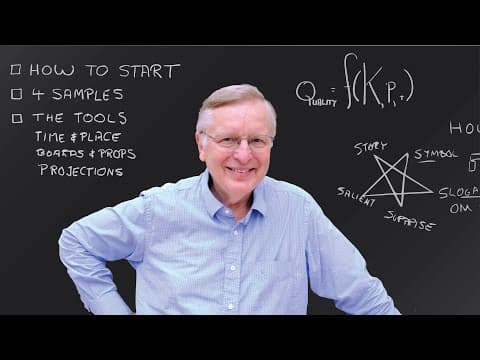
An MIT institution for four decades: concrete heuristics on blackboard pacing, cycling ideas, verbal punctuation, and why you should never open a technical talk with a joke.
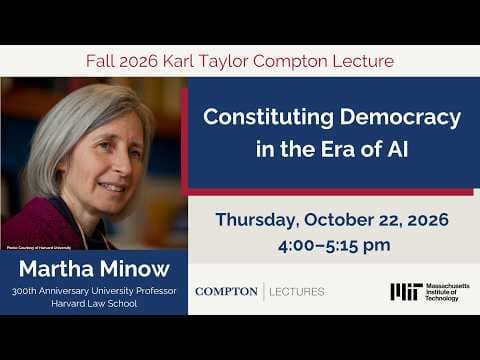
Professor Minow explores the evolving challenges to democratic governance and constitutional frameworks posed by the pervasive influence of artificial intelligence. The lecture analyzes how AI systems necessitate re-evaluation of established legal principles and societal structures for maintaining democratic integrity.
A philosophical inquiry into the concept of justice, drawn from Lecture 4 of a Yale course examining the foundational purposes of college education through classical texts.
An academic exploration of Yale's role during the American Revolution, positioned as Lecture 6 in a course on the broader purposes of college education.
Metaphysics of consciousness, neurobiology of behavior, and theories of justice
Yale University · Stanford University · Harvard University