
Principles of Chemical Science
Catherine DrennanAtomic orbitals, molecular orbital theory, VSEPR geometry, thermodynamics, chemical equilibrium, acid-base titration, electrochemistry, transition metals, and reaction kinetics.

Syllabus
22The Importance of Chemical Principles
Professor Catherine Drennan introduces the fundamental principles underpinning chemical science, outlining the course's objectives and illustrating how these concepts are applied to solve real-world problems. The lecture emphasizes the foundational role of chemistry in scientific understanding.
Atomic Structure
This lecture introduces fundamental concepts of atomic structure, featuring a classroom demonstration replicating Rutherford's gold foil experiment to illustrate the nuclear model of the atom.

Wave-Particle Duality of Light
This lecture introduces the foundational concept of wave-particle duality, detailing the wave properties of light and their manifestation through diffraction phenomena, alongside an initial exploration of light's particulate nature.
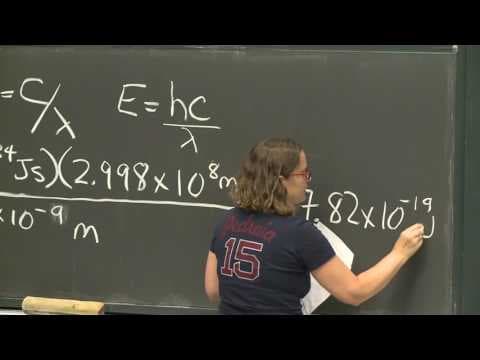
Wave-Particle Duality of Matter; Schrödinger Equation
This lecture introduces the fundamental concept of wave-particle duality for matter, specifically electrons. It also examines the initial impact of the Schrödinger equation on atomic theory and explores quantum dot technology.

Hydrogen Atom Energy Levels
This lecture introduces the empirical observations of the hydrogen atom's visible spectrum and develops the quantum mechanical explanation for its discrete energy levels. It explores the foundational principles governing atomic electron transitions.
Hydrogen Atom Wavefunctions (Orbitals)
This lecture introduces the quantum mechanical description of the hydrogen atom, detailing the concept of electron wavefunctions (orbitals) and the probability distributions of electrons. It covers the application of electron spin in magnetic resonance imaging.
Multielectron Atoms
This lecture introduces the complexities of multielectron atoms, moving beyond the hydrogenic model to address electron shielding effects. It details how electron configurations are derived and used to describe atomic structure.

The Periodic Table and Periodic Trends
This lecture introduces the foundational principles of the periodic table, exploring its organization and the periodic trends that govern elemental properties. It highlights how these trends reveal fundamental chemical relationships.
Periodic Table; Ionic and Covalent Bonds
This session concludes the periodic table discussion, delving into the formation of ionic and covalent bonds. It further examines electronegativity's role in bond characteristics and its application in antibiotic design.
Lewis Structures
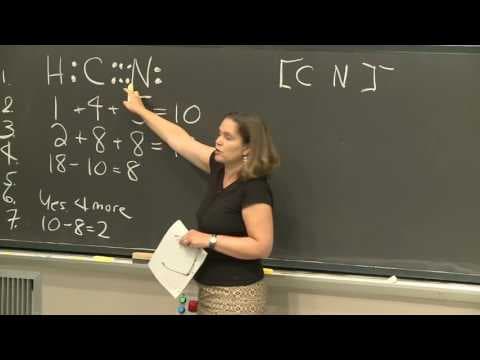
This lecture focuses on Lewis structures, a simplified model for visualizing molecular electron configurations and covalent bonding. It demonstrates how electron sharing helps atoms achieve noble gas configurations.
Formal Charge and Resonance
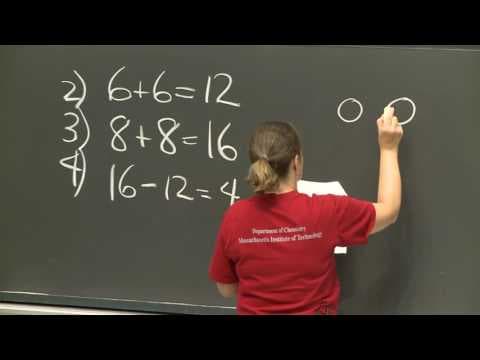
Building on Lewis structures, this lecture introduces formal charge and the concept of resonance, elucidating how these principles describe delocalized electrons in molecules. It also covers radicals and expanded octets.
The Shapes of Molecules: VSEPR Theory
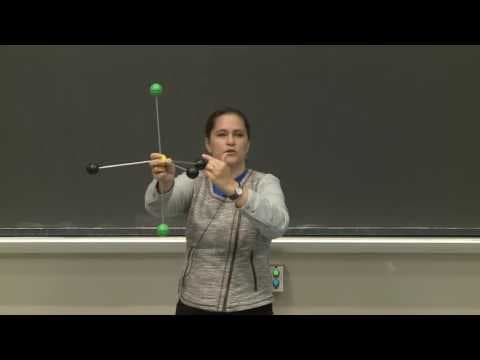
This lecture explores Valence Shell Electron Pair Repulsion (VSEPR) theory to predict molecular geometry. It explains how minimizing electron repulsion around a central atom dictates molecular shapes and discusses its application in sensor design.
Molecular Orbital Theory
This lecture introduces the foundational principles of molecular orbital theory, applying the model to explain the existence and stability of diatomic molecules such as H at_2 and He at_2. It elucidates how the combination of atomic orbitals leads to bonding and antibonding molecular orbitals.
Valence Bond Theory and Hybridization
This lecture delves into Valence Bond Theory and the concept of hybridization, crucial for explaining molecular geometry and bonding, particularly in organic molecules. It outlines how atomic orbitals combine to form hybrid orbitals.
Thermodynamics: Bond and Reaction Enthalpies
This introductory lecture on thermodynamics defines bond and reaction enthalpies (∆H), examining the heat changes associated with bond breaking and formation. It provides a foundation for understanding molecular reactivity and energy transfer.

Thermodynamics: Gibbs Free Energy and Entropy
This lecture explores the concepts of Gibbs Free Energy and Entropy, fundamental for predicting the spontaneity of chemical reactions. It examines how these thermodynamic properties determine reaction favorability.
Thermodynamics: Now What Happens When You Heat It Up?
This session applies thermodynamic principles to everyday phenomena, particularly cooking, and biological systems. It emphasizes the importance of weak interactions, such as hydrogen bonds, in chemical and biological processes.

Introduction to Chemical Equilibrium
This lecture introduces the concept of chemical equilibrium, where forward and reverse reaction rates are balanced. It discusses the equilibrium constant and how external factors can shift equilibrium, including its relevance in living organisms.
Chemical Equilibrium: Le Châtelier’s Principle
This session focuses on Le Châtelier’s Principle, explaining how a system at equilibrium responds to minimize applied stress. It demonstrates how changes in concentration, pressure, or temperature affect reaction direction.
Solubility and Acid-Base Equilibrium
This lecture introduces the principles governing chemical solubility and acid-base equilibrium, discussing the common ion effect and calculating solubility product constants for ionic compounds.
Acid-Base Equilibrium: Is MIT Water Safe to Drink?
This lecture introduces the concept of pH, a crucial measure in acid-base chemistry, and explores its implications for water safety. Various common solutions are measured to illustrate pH scale applications.
Acid-Base Equilibrium: Salt Solutions and Buffers
This session delves into the behavior of salt solutions and the design of buffer systems, which maintain constant pH. It illustrates buffering capacity in biological systems and how to predict the pH of various salt solutions.