
Underactuated Robotics
Prof. Russ TedrakeNonlinear dynamics, phase-portrait geometry, dynamic programming, trajectory optimization, Lyapunov sum-of-squares verification, legged locomotion, and contact-rich manipulation.
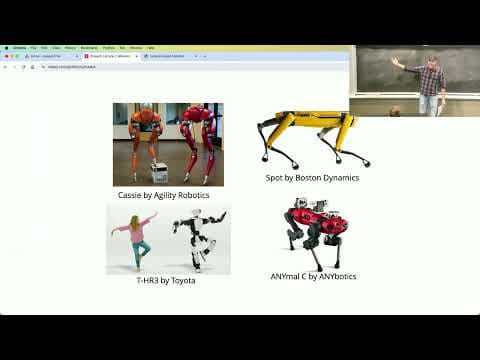
Syllabus
22Robot Dynamics and Model-Based Control (MIT 6.8210, Lecture 1)
This lecture introduces fundamental principles of robot dynamics, deriving equations of motion using Lagrangian mechanics. It establishes the basis for model-based control strategies, covering concepts essential for analyzing complex robotic systems.
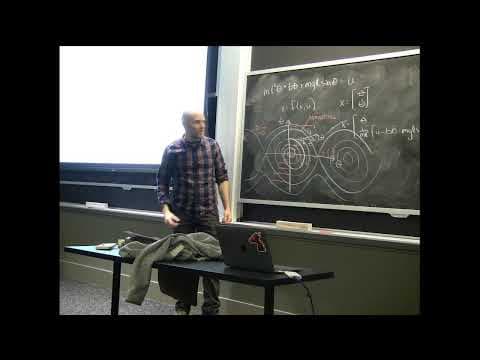
Spring 2023 6.8210 Lecture 2: Nonlinear Dynamics
This lecture introduces the fundamental concepts of nonlinear dynamical systems, analyzing system behavior, stability criteria, and phase-space analysis relevant to underactuated robotics. Key topics include fixed points, limit cycles, and basic Lyapunov stability theory.
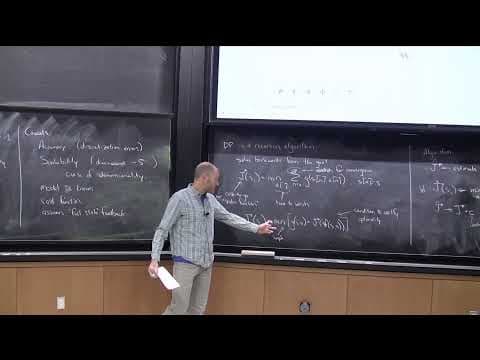
Lecture 3 | MIT 6.832 (Underactuated Robotics), Spring 2020 | Dynamic Programming I
This lecture introduces the foundational concepts of dynamic programming within the context of optimal control for underactuated robotic systems. It covers Bellman's principle of optimality and its application to discrete-time finite-horizon problems.
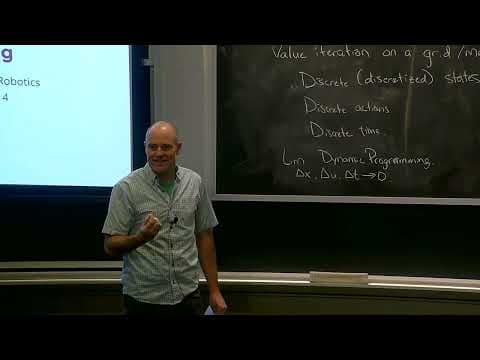
Dynamic Programming II (MIT 6.8210, Lecture 4)
This lecture extends the foundational principles of dynamic programming, focusing on advanced applications relevant to optimal control and decision-making under uncertainty. It likely covers Bellman equations and value iteration in complex state spaces.
Acrobots, Cart-poles, and Quadrotors I (MIT 6.8210/6.832 Lecture 5)
This lecture introduces the dynamics and control challenges inherent in underactuated systems through canonical examples such as acrobots, cart-poles, and quadrotors, laying the groundwork for nonlinear control strategies.
Dynamic Programming III (MIT 6.8210, Lecture 6)
This lecture extends dynamic programming, focusing on its application to continuous state and action spaces, drawing connections to Hamilton-Jacobi-Bellman equations and their numerical approximation. It explores value iteration and policy iteration for optimal control problems.
Lyapunov Analysis I (MIT 6.8210, Lecture 7)
This lecture introduces the foundational concepts of Lyapunov stability theory for analyzing nonlinear dynamical systems. It details the construction and properties of Lyapunov functions to determine system stability without explicitly solving differential equations.
Computing Lyapunov Functions I (MIT 6.8210/6.832, Lecture 8)
This lecture introduces the foundational concept of Lyapunov functions for analyzing stability in nonlinear control systems, focusing on methods for their computational synthesis. The session covers stability definitions, invariant set theorems, and initial approaches to constructing Lyapunov functions via convex optimization.
Lecture 9: Computing Lyapunov Functions II (6.832)
This lecture continues the exploration of Lyapunov function computations, focusing on advanced techniques and their application to underactuated robotic systems. It details methods for proving stability and designing controllers.
Lecture 10: Trajectory Optimization I (6.832)
This lecture introduces the foundational concepts and mathematical formulations of trajectory optimization, focusing on direct and indirect methods for solving optimal control problems in robotics. It lays the groundwork for applying nonlinear programming techniques to dynamic systems.
Lecture 11: Trajectory Optimization II (6.832)
This lecture, part of MIT 6.8210 (Underactuated Robotics), continues the in-depth treatment of trajectory optimization, focusing on advanced techniques and their application in complex robotic systems. It builds upon foundational concepts to address practical challenges in motion planning.
Lecture 12: Trajectory Stabilization (6.832)
This lecture addresses the critical problem of stabilizing dynamic systems along a desired trajectory, introducing methods like Linear Quadratic Regulator (LQR) and model predictive control (MPC) for robust performance.
Lecture 15: Simple Models of Walking (6.832)
This lecture investigates simplified dynamic models to understand the mechanics of bipedal locomotion, focusing on concepts like the compass gait and inverted pendulum models. It analyzes stability and energy efficiency in walking.
Lecture 14: Hybrid Trajectory Optimization (6.832)
This lecture examines trajectory optimization for systems with both continuous and discrete dynamics, crucial for tasks involving contacts and mode changes. It covers techniques for solving hybrid optimal control problems.
Lecture 15: Planning + Control Through Contact (6.832)
This session addresses the complex problem of planning and controlling robotic interactions involving contact forces and transitions. It introduces models for friction and impact, and algorithms for robust contact manipulation.
Lecture 16: Humanoid Robots (6.832)
This lecture explores the control and planning challenges inherent in humanoid robotics, covering topics such as balance, whole-body control, and motion generation for complex multi-joint systems.
Lecture 17: Mixed-discrete (combinatorial) and continuous optimization (6.832)
This lecture introduces the formalisms and solution strategies for mixed-discrete and continuous optimization problems, examining the interplay between combinatorial decision-making and continuous variable landscapes.
Lecture 18: Sampling-based (kinodynamic) motion planning (6.832)
This session covers sampling-based motion planning algorithms like RRT and PRM, emphasizing kinodynamic constraints for systems with differential equations. It details efficient pathfinding in high-dimensional spaces.
Lecture 19: Stochastic dynamics (6.832)
This lecture introduces the mathematical framework for modeling systems subject to random disturbances, exploring concepts like Wiener processes and Ito calculus. It lays the groundwork for understanding noise in robotic systems.
Lecture 20: Stochastic Control (6.832)
Building on stochastic dynamics, this lecture delves into designing controllers for systems operating under uncertainty, introducing concepts like Kalman filtering and optimal stochastic control via the Hamilton-Jacobi-Bellman equation.
Lecture 21: Robust Control & Policy Search (6.832)
This lecture addresses methods for designing controllers that maintain performance despite model uncertainties and external disturbances. It explores robust control theory principles and introduces policy search algorithms for reinforcement learning.
Lecture 22: Output feedback (6.832)
This lecture examines control strategies that rely solely on measured outputs rather than full state information, discussing observer design and the separation principle. It details how to achieve stability and performance with incomplete state knowledge.