
The Early Middle Ages, 284–1000
Traces late Roman transformation, Christianization, Byzantium, the rise of Islam and the Abbasid Caliphate, monasticism, Charlemagne's Carolingian Empire, and Viking expansion.
Syllabus
22Course Introduction: Rome's Greatness and First Crises
This introductory lecture establishes the core themes of Yale's 'Early Middle Ages' course, examining the structural strengths and emerging vulnerabilities of the Roman Empire prior to the pivotal Crisis of the Third Century, setting the stage for discussions on Christianization and barbarian incursions.
The Crisis of the Third Century and the Diocletianic Reforms
This lecture analyzes the political, economic, and military crises of the Roman Empire during the third century CE, examining the internal struggles of succession and inflation, and detailing the structural reforms implemented by Emperor Diocletian, including the Tetrarchy.
Constantine and the Early Church
This lecture analyzes the pivotal reign of Emperor Constantine, examining his conversion, the establishment of Constantinople, and his profound impact on the evolving relationship between the Roman state and the early Christian Church.
The Christian Roman Empire
This lecture examines the Christianization of the Roman Empire, analyzing the reigns of Constantine and Julian the Apostate. It details the theological disputes of Arianism, Donatism, and Manichaeism, and introduces Augustine's Confessions within a Platonist framework.
St. Augustine's Confessions
Professor Freedman analyzes St. Augustine's Confessions, examining its contribution to understanding Late Antique intellectual life, the impact of Christianity on the Roman Empire, and early Church doctrinal concerns including the problem of evil, the soul-body distinction, and sin and redemption.
Transformation of the Roman Empire
Professor Freedman analyzes the political collapse of the Western Roman Empire in the 5th century, examining the interplay of external invasions and internal institutional decline. He assesses whether this transformation represented a gradual shift or a cataclysmic end to a specific civilization.
Barbarian Kingdoms
This lecture examines the formation of post-Roman barbarian kingdoms, analyzing Roman accommodation policies, the organizational structures of tribes such as the Ostrogoths and Vandals, and intellectual life after 476 CE. It concludes with an analysis of the Burgundian Code as primary legal evidence.
Survival in the East
This lecture examines how the Eastern Roman (Byzantine) Empire survived the fifth-century Western collapse, contrasting its urbanization and economic strength with the West's fragmentation. Procopius's Secret History offers a critical perspective on Emperor Justinian's reign and the later pressures from Persia, Slavs, Avars, and Arabs.
The Reign of Justinian
This session evaluates primary sources like Procopius's The Wars, Buildings, and Secret History for insights into Emperor Justinian's reign. It details Justinian and Theodora's efforts to reclaim lost territories and the resulting civil unrest from heavy taxation and military campaigns.
Clovis and the Franks
This lecture analyzes Gregory of Tours' history of the Merovingian kings, contrasting its style with Procopius's classical invective. It highlights Clovis's establishment of Frankish hegemony and the significance of their Catholic conversion in post-Roman Gaul.
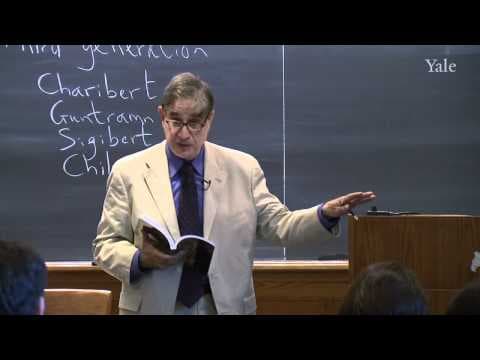
Frankish Society
This lecture examines Merovingian society as a model of barbarian kingship, sustained by kinship, private vengeance, and religious authority. It interprets Gregory of Tours' view on violence as a tool for royal power and divine retribution, concluding with the Merovingian decline.
Britain and Ireland
This lecture explores the British Isles as a post-Roman frontier society, noting England's economic simplification after Roman withdrawal and the subsequent flourishing of written culture following Christianization. It contrasts the hierarchical Roman-influenced English Church with the decentralized, pre-Roman Irish Church.
Monasticism
This lecture delves into the paradoxes of early medieval monasticism, tracing its evolution from eremetic asceticism in the East to communal life under the Rule of St. Benedict. It reveals how the emphasis on prayer and labor in the Benedictine Rule inadvertently fostered manuscript copying and intellectual pursuits.
Mohammed and the Arab Conquests
This lecture introduces Islam, contextualizing its rise within the Arabian peninsula's tribal Bedouin society and their opportunistic raids against the weakened Byzantine and Persian Empires. It details the life and revelations of Mohammed, emphasizing the nascent theological principles of monotheism and prophetic succession.
Islamic Conquests and Civil War
This lecture chronicles the swift Islamic conquests, clarifying that they were not driven by forced conversions but by a strategic exploitation of Byzantine and Persian weakness, spanning from Spain to India. It then addresses the internal theological and political divisions within early Islam concerning the Caliphate and succession.
The Splendor of the Abbasid Period
This lecture details the Abbasid dynasty, highlighting its move of the Caliphate to Baghdad and the creation of a robust administrative and taxation system. It explores the Abbasid era's cultural flourishing, particularly its role in translating classical Greek and Roman texts and advancing mathematics and astronomy.
The Crucial Seventh Century
This lecture continues the Abbasid discussion, emphasizing their cultural assimilation and tenth-century decline, then pivotally examines the 'crucial seventh century.' It underscores this period's fundamental shifts: the rise of Islam, reorientation of Byzantium and Persia, and the end of the Western secular elite, concluding with the Pirenne thesis.
The Splendor of Byzantium
This lecture surveys Byzantine history from the sixth to eleventh centuries, delineating periods of Justinian expansion, subsequent crisis and contraction, military reorganization, and intense theological conflicts over Iconoclasm. It traces the Empire's fluctuating fortunes and internal struggles.
Charlemagne
This lecture traces the Carolingian dynasty's rise to power, focusing on their legitimacy through military leadership, Christian rule, and Roman legacy, culminating in Charlemagne's emperorship. It details key events like Charles Martel's victory at Poitiers and Pepin the Short's alliance with the papacy.
Intellectuals and the Court of Charlemagne
This lecture explores the Carolingian Renaissance, a revival of learning sponsored by Charlemagne to enhance government and piety amidst declining lay literacy. It highlights the role of monasteries and scriptoria in manuscript copying and discusses Einhard's writings, illustrating the period's evolving religious narratives.
Crisis of the Carolingians
This lecture analyzes the collapse of Charlemagne's empire, attributing it to internal governance issues and external Viking threats. It details how the lack of strong infrastructure led to hereditary offices and independent kingdoms, yet acknowledges the Carolingian legacy in shaping European territories via the Treaty of Verdun.
Vikings / The European Prospect, 1000
This lecture details the adaptive nature of Viking expansion—raiding, trading, and settling—from Scandinavia across diverse regions, creating extensive global networks. It concludes with a comprehensive review of Europe's trajectory from 284 to 1000 CE, contrasting its challenges with those of the Roman Empire.