
Philosophy and the Science of Human Nature
Pairs Plato, Aristotle, Epictetus, Hobbes, Kant, and Mill with contemporary cognitive science, behavioral economics, and moral psychology on flourishing, habit, and justice.
Syllabus
22Introduction
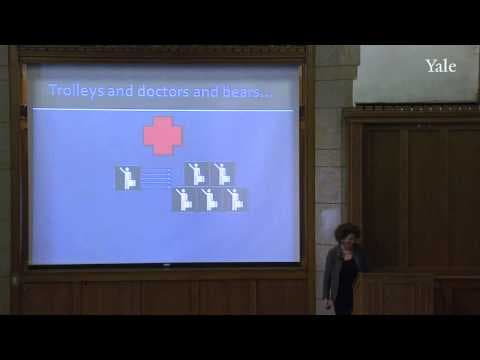
This inaugural lecture introduces the interdisciplinary scope of Yale's PHIL 181, integrating philosophical inquiry with insights from psychology and behavioral economics. It previews core themes through classic thought experiments such as Plato's Ring of Gyges and the Trolley Problem, and examines the concept of procrastination.
The Ring of Gyges: Morality and Hypocrisy
This lecture analyzes Glaucon's challenge in Plato's Republic Book II, employing the Ring of Gyges thought experiment to question intrinsic moral value. It then connects this classical problem to Daniel Batson's empirical research on moral hypocrisy.
Parts of the Soul I
This lecture examines historical and psychological models of intrapersonal division, analyzing Plato's tripartite soul (reason, spirit, appetite), Hume's reason-passion dichotomy, Freud's id-ego-superego, and Jonathan Haidt's four divisions of the mind, with a specific focus on Plato's Phaedrus.
Parts of the Soul II
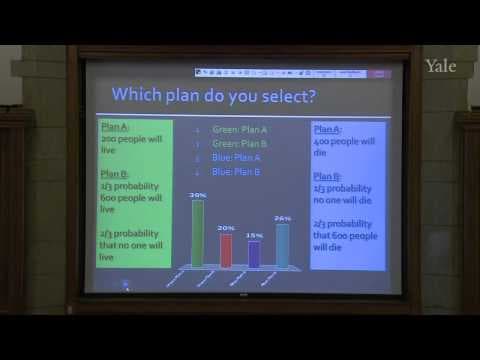
Professor Gendler examines dual-processing accounts of cognition via the Wason selection task, explores Kahneman and Tversky's work on framing effects including the Asian disease problem, and introduces the concept of 'alief' distinct from belief.
The Well-Ordered Soul: Happiness and Harmony
Professor Gendler analyzes Plato's analogy of the city-state and the soul, articulating his response to Glaucon's challenge that justice is intrinsically valuable as a well-ordered state of the individual. The lecture concludes with an introduction to Aristotle's teleological argument for human happiness.
The Disordered Soul: Thémis and PTSD
This lecture explores Aristotle's concept of virtue as the alignment of instinct and reflective commitment, contrasting it with the dissonance experienced in PTSD. It analyzes Jonathan Shay's interpretation of the Iliad in relation to moral injury among soldiers, focusing on the betrayal of 'thémis'.
Flourishing and Attachment
This lecture analyzes Stanley Milgram's obedience experiments to explore the impact of proximity on moral behavior, then reviews Harry Harlow's research on attachment in primates and infants, connecting these findings to theories of social interaction and human flourishing.
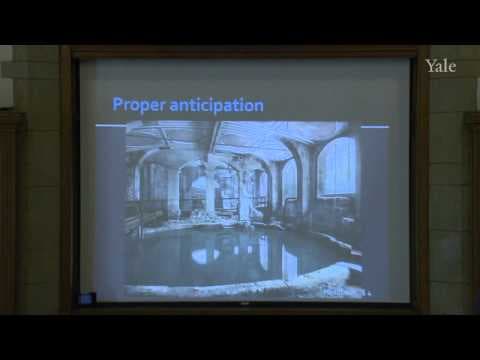
Flourishing and Detachment
This lecture analyzes Epictetus's Stoic philosophy, particularly the distinction between what is within and beyond our control, arguing for detachment from external desires to cultivate internal happiness. It further explores similar themes in Boethius's "The Consolation of Philosophy" and applies these concepts to practical scenarios, referencing Admiral James Stockdale's experiences.
Virtue and Habit I
This lecture explores Aristotle's concept that virtue is acquired through habitual action, bridging normative and descriptive laws. It draws parallels between Pavlovian conditioning, parenting, and virtue acquisition.
Virtue and Habit II
Continuing Aristotle's virtue ethics, this session discusses the importance of acting virtuously for its own sake and with pleasure. It connects Julia Annas's work to Mihaly Csikszentmihalyi's concept of flow.
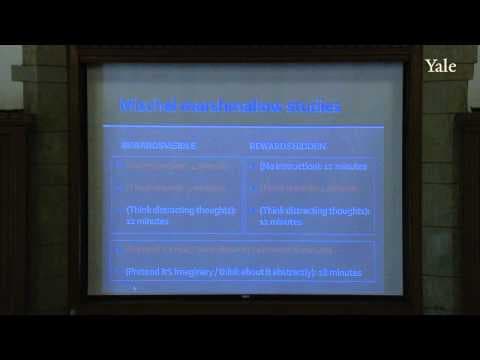
Weakness of the Will and Procrastination
This lecture reviews the situationist critique of virtue ethics, presenting Walter Mischel's marshmallow test and Aristotle's account of weakness of will. It examines hyperbolic discounting in behavioral economics.
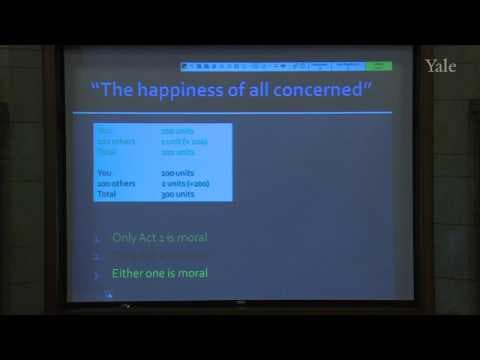
Utilitarianism and its Critiques
This session introduces various moral theories, focusing on John Stuart Mill's utilitarianism and the Greatest Happiness Principle. It presents Ursula Le Guin's story to challenge the utilitarian framework.
Deontology
This lecture presents Bernard Williams's objection to utilitarianism, then introduces Immanuel Kant's deontological moral theory. It emphasizes the will of the agent over the outcome in moral evaluation.
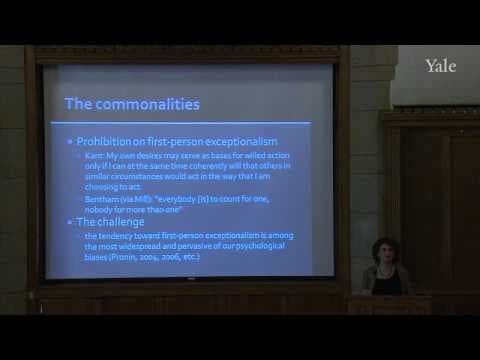
The Trolley Problem
Continuing Kant, this lecture explicates the categorical imperative and its application to moral duties. It then introduces Philippa Foot's Trolley Problem and Judith Jarvis Thomson's proposed solutions.
Empirically-informed Responses
This lecture explores various non-classic, empirically-informed responses to the Trolley Problem, aiming to reconcile conflicting moral judgments. It highlights diverse methodologies in philosophical inquiry.
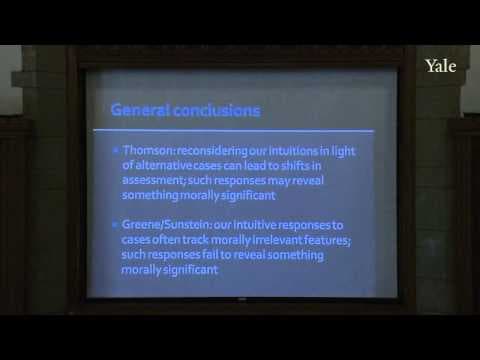
Philosophical Puzzles
This session concludes the Trolley Problem with Cass Sunstein's resolution and discusses heuristics in risk regulation. It introduces the puzzles of ducking vs. shielding and moral luck.
Punishment I
This lecture introduces the concept of civil punishment, distinguishing between forward-looking and backward-looking justifications. It examines retributivism in detail and connects various theories of punishment to foundational moral frameworks such as utilitarianism and deontology.
Punishment II
This lecture analyzes the consequentialist and two-level theories of punishment, integrating John Rawls' framework. It further reviews empirical studies on punishment intuitions, including moral outrage and the Knobe effect, concluding with the interaction of moral luck and penal judgments.
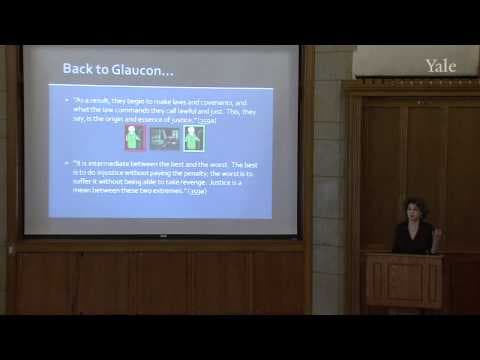
Contract & Commonwealth: Thomas Hobbes
Concluding punishment with Alan Kazdin's work on rehabilitation, this lecture introduces Thomas Hobbes's social contract theory. It explores the 'state of nature' and the rationale for forming a commonwealth.
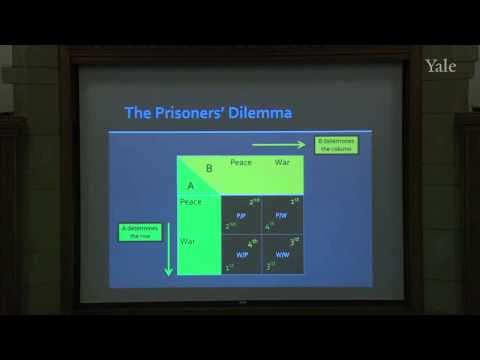
The Prisoner's Dilemma
This lecture delves into two game theory problems: the Prisoner's Dilemma and the Problem of the Commons. It analyzes how individual rational choices can lead to collectively suboptimal outcomes and offers solutions.
Equality
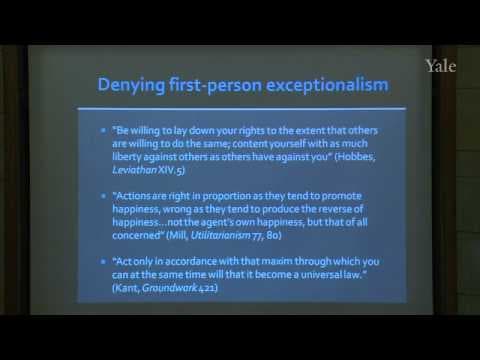
This session introduces John Rawls's A Theory of Justice, exploring the concept of the 'veil of ignorance.' It derives Rawls's two principles of justice: equal liberty and the difference principle.
Equality II
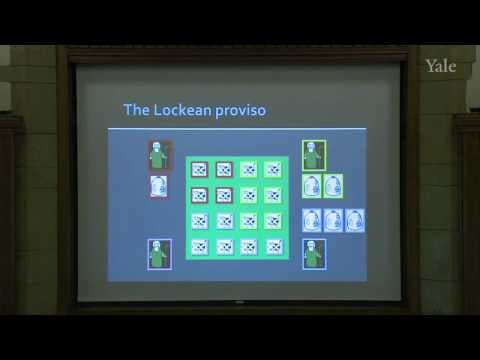
This lecture contrasts Robert Nozick's Anarchy, State, and Utopia with Rawls, emphasizing rights and liberties over justice. It examines Nozick's principles of justice in acquisition and transfer, and the Wilt Chamberlain argument.