Computer Architecture: From Pipelines to Parallelism
This study path systematically builds understanding of computer architecture, starting with fundamental compiler interactions and processor optimizations. It progresses through memory management, cache hierarchies, and advanced branch prediction, culminating in the exploration of GPU-native execution and specialized AI hardware architectures.
Explore the design principles of modern processors, memory hierarchies, and parallel computing paradigms.
6steps9htotal runtime
Step 1 of 6
Path progress0 of 6 watched
Curriculum sequence
6
What Compilers Can and Cannot Do
This foundational lecture establishes how compilers translate code and the inherent limitations, setting the stage for understanding how hardware design must accommodate software.
Step 2·Zig Software Foundation·Andrew Kelley· 46:40

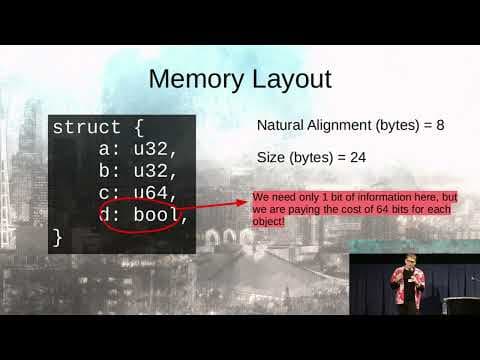
A Practical Guide to Data-Oriented Design
Building on compiler understanding, this lecture demonstrates how data-oriented design principles directly impact memory footprint and execution speed, crucial for efficient hardware utilization.
Cache-Oblivious Algorithms
With a grasp of data layout, this step introduces cache-oblivious algorithms, illustrating how to design software that performs well across different memory hierarchies without explicit tuning.
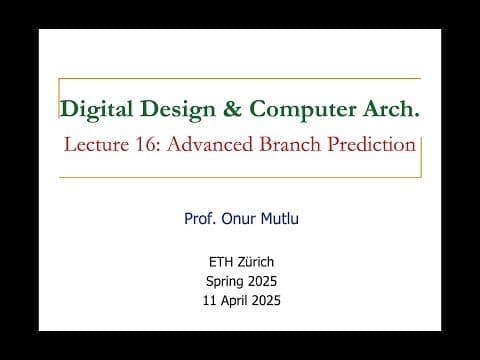

Advanced Branch Prediction
Moving beyond memory, this lecture delves into advanced branch prediction, a critical processor optimization technique that significantly impacts instruction pipeline efficiency and overall performance.

Step 5·Carnegie Mellon University·Xiangyao Yu· 1:07:27

Sirius: A GPU-Native SQL Engine
Leveraging knowledge of processor optimizations and memory, this lecture explores GPU-native SQL engines, showcasing how specialized architectures handle massive parallel data processing.

Step 6·GPU MODE·Chris Lattner· 2:13:36

Mojo: Modular's Unified Device Accelerator Language
Finally, this step examines Mojo, a language designed for AI hardware, integrating concepts of compilers, data layout, and specialized accelerators for cutting-edge computational demands.
Companion reading for this sequence
2Amazon Associate

Course TextbookMorgan Kaufmann · 6th Edition (2017)
Computer Architecture: A Quantitative Approach
By John L. Hennessy & David A. Patterson
Turing Laureates Hennessy and Patterson's definitive reference on memory hierarchies, instruction-level parallelism, and domain-specific accelerators.
Assigned syllabus text for 252-0028 · Matches 3 steps in pathISBN 978-0128119051
View on Amazon
Course TextbookMIT Press · 4th Edition (2022)
Introduction to Algorithms (CLRS)
By Thomas H. Cormen, Charles E. Leiserson, Ronald L. Rivest et al.
Co-authored by MIT lecturers Charles Leiserson and Ronald Rivest—the canonical syllabus textbook for MIT 6.006 and 6.046J algorithm design and analysis.
Assigned syllabus text for 6.172 · Matches 2 steps in pathISBN 978-0262046305
View on Amazon