The Cryptographic Revolution: From Zero-Knowledge to Post-Quantum Frontiers
This study path traces the intellectual arc of modern cryptography, beginning with the theoretical underpinnings of computational hardness and interactive proofs. It then progresses through the practical construction of secure systems, culminating in an examination of cutting-edge research in post-quantum cryptography and its implications for future security.
Explore the evolution of cryptography, from foundational interactive proofs to advanced secure computation and post-quantum challenges.
6steps8htotal runtime
Step 1 of 6
Path progress0 of 6 watched
Curriculum sequence
6Step 1·Institute for Advanced Study·Avi Wigderson· 1:02:49

Mathematics and Computation: The Landscape of P vs. NP
This foundational lecture establishes the critical concept of computational hardness, which is essential for understanding the security basis of all modern cryptographic systems.
Step 2·MIT·Silvio Micali· 1:03:26

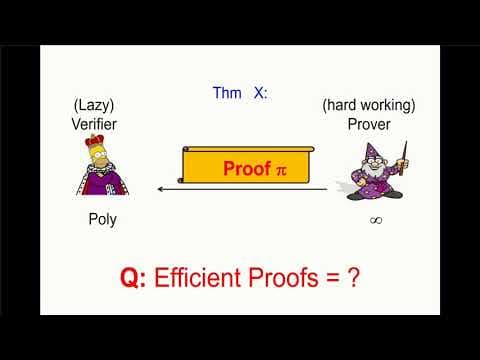
Proofs, Knowledge, and Computation: Zero-Knowledge Interactive Systems
Building on computational hardness, this lecture introduces zero-knowledge interactive proofs, demonstrating how interaction and randomness enable verifiable computation without revealing sensitive information.

IP = PSPACE
Expanding on interactive proofs, this lecture delves into the theoretical power of IP systems, showing their equivalence to PSPACE and highlighting their broad computational capabilities.

Step 4·Simons Institute (UC Berkeley)·Shafi Goldwasser· 1:02:15

What Can the Theory of Cryptography Tell Us About AI Verification?
Applying the principles of interactive proofs and cryptographic techniques, this lecture explores their practical utility in verifying complex systems like AI, showcasing real-world applications of theoretical concepts.

SHA-3 Hash Function
Transitioning from theoretical proofs to practical primitives, this lecture examines the SHA-3 hash function, a core component in many cryptographic protocols, illustrating concrete construction methods.
Introduction to Hash-based Post-quantum Cryptography (PQC)
Finally, this lecture addresses the future of cryptography by introducing hash-based post-quantum cryptography, building on hash function knowledge to tackle emerging threats from quantum computing.
Companion reading for this sequence
2Amazon Associate

By the LecturerPrinceton University Press · 1st Edition (2019)
Mathematics and Computation: A Theory Revolutionizing Technology and Science
By Avi Wigderson
Turing and Abel Prize Laureate Avi Wigderson's sweeping monograph on P vs. NP, randomness, zero-knowledge proofs, and computational complexity.
Book by Avi Wigderson featured in this lecture · Matches 2 steps in pathISBN 978-0691189130
View on Amazon
Lecturer's Course TextSpringer · 1st Edition (2009)
Understanding Cryptography: A Textbook for Students and Practitioners
By Christof Paar & Jan Pelzl
Christof Paar's companion textbook written specifically to accompany his 24-lecture Introduction to Cryptography university course.
Written by Christof Paar for CRYPTO-101 · Matches 2 steps in pathISBN 978-3642041006
View on Amazon