Alan Guth
Victor Weisskopf Professor of Physics at the Massachusetts… · MIT · Breakthrough Laureate · author of The Inflationary Universe
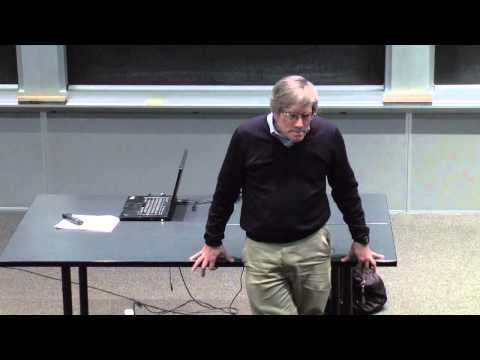
Alan Guth is the Victor Weisskopf Professor of Physics at MIT, known for pioneering cosmic inflation, for which he won the 2014 Kavli Prize.
- lectures
- 22
- series
- 1
- hours
- 27
Start here


Series and courses
MIT 8.286: The Early Universe
Open the course
- 1Inflationary Cosmology: Is Our Universe Part of a Multiverse? Part I
- 2Inflationary Cosmology: Is Our Universe Part of a Multiverse, Part II
- 3The Doppler Effect and Special Relativity
- 4The Kinematics of the Homogeneous Expanding Universe
Show 18 moreShow fewer
- 5Cosmological Redshift and the Dynamics of Homogeneous Expansion, Part I
- 6The Dynamics of Homogeneous Expansion, Part II
- 7The Dynamics of Homogeneous Expansion, Part III
- 8The Dynamics of Homogeneous Expansion, Part IV
- 9The Dynamics of Homogeneous Expansion, Part V
- 10Introduction to Non-Euclidean Spaces
- 11Non-Euclidean Spaces: Closed Universes
- 12Non-Euclidean Spaces: Open Universes and the Spacetime Metric
- 13Non-Euclidean Spaces: Spacetime Metric and Geodesic Equation
- 14The Geodesic Equation
- 15Black-Body Radiation and the Early History of the Universe, Part I
- 16Black-Body Radiation and the Early History of the Universe, Part II
- 17Black-Body Radiation and the Early History of the Universe, Part III
- 18Cosmic Microwave Background Spectrum and the Cosmological Constant, Part I
- 19The Cosmological Constant, Part II
- 20Supernovae Ia and Vacuum Energy Density
- 21Problems of the Conventional (Non-inflationary) Hot Big Bang Model
- 23Inflation
In these lectures
- Non-Euclidean geometry differs from Euclidean geometry entirely in its rejection of Euclid's fifth postulate.Non-Euclidean Spaces: Closed Universes
- The standard Big Bang model assumes the universe began 13.82 billion years ago as a hot, dense soup.Inflationary Cosmology: Is Our Universe Part of a Multiverse? Part I
- Type Ia supernovae measurements in 1998 led astronomers to conclude that the universe is accelerating, requiring a significant component of vacuum energy.Supernovae Ia and Vacuum Energy Density
Draws on
People cited in the lectures, at the moment of the citation.
- Albert EinsteinIntroduced general relativity and the cosmological constant in 1916.
- Felix KleinMathematician who provided a coordinate representation for GBL geometry in 1870.
- Carl Friedrich GaussGerman mathematician and physicist who developed non-Euclidean geometry.
- Nikolai LobachevskyMathematician who independently developed non-Euclidean geometry.
- Alexander FriedmannRussian meteorologist and mathematician who first derived the Friedmann equations in 1922 and 1923.
- Alexander FriedmanDerived the Friedmann equations from general relativity in 1922.
Playlists
1

About
Alan Guth is the Victor Weisskopf Professor of Physics at MIT, known for pioneering cosmic inflation, for which he won the 2014 Kavli Prize. His MIT 8.286 lectures derive the Robertson-Walker metric and geodesic equation, trace black-body radiation in the early universe, and weigh supernova evidence for vacuum energy.
Taught with
Same subject, Physics & Cosmology
Connections
26Their places, courses, books and lectures.
Institution1
Concept1
Lectures22
- Non-Euclidean Spaces: Closed Universes
- Inflationary Cosmology: Is Our Universe Part of a Multiverse? Part I
- Supernovae Ia and Vacuum Energy Density
- Black-Body Radiation and the Early History of the Universe, Part III
- Cosmological Redshift and the Dynamics of Homogeneous Expansion, Part I
- Non-Euclidean Spaces: Spacetime Metric and Geodesic Equation
Show 16 moreShow fewer
- Cosmic Microwave Background Spectrum and the Cosmological Constant, Part I
- Black-Body Radiation and the Early History of the Universe, Part I
- The Dynamics of Homogeneous Expansion, Part II
- The Dynamics of Homogeneous Expansion, Part III
- The Dynamics of Homogeneous Expansion, Part IV
- The Cosmological Constant, Part II
- The Geodesic Equation
- The Doppler Effect and Special Relativity
- The Kinematics of the Homogeneous Expanding Universe
- Non-Euclidean Spaces: Open Universes and the Spacetime Metric
- Problems of the Conventional (Non-inflationary) Hot Big Bang Model
- Inflationary Cosmology: Is Our Universe Part of a Multiverse, Part II
- Introduction to Non-Euclidean Spaces
- Black-Body Radiation and the Early History of the Universe, Part II
- The Dynamics of Homogeneous Expansion, Part V
- Inflation