2. Risk and Financial Crises

Sterling Professor of Economics & Nobel Laureate
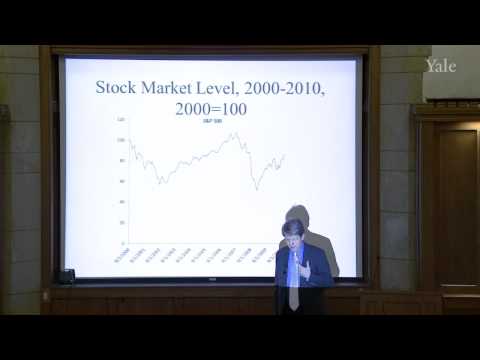
This lecture introduces probability theory, including expected value, variance, and covariance, within the context of the 2007-2008 financial crisis. Professor Shiller analyzes the impact of independence assumptions on Value at Risk and distinguishes between idiosyncratic and systematic risk using regression analysis. The session concludes with a discussion of fat-tailed distributions in financial returns.
Financial Markets (2011) (ECON 252)
Professor Shiller introduces basic concepts from probability theory and embeds these concepts into the concrete context of financial crises, with examples from the financial crisis from 2007-2008. Subsequent to a historical narrative of the financial crisis from 2007-2008, he turns to the definition of the expected value and the variance of a random variable, as well as the covariance and the correlation of two random variables. The concept of independence leads to the law of large numbers, but financial crises show that the assumption of independence can be deceiving, in particular through its impact on the computation of Value at Risk measures. Moreover, he covers regression analysis for financial returns, which leads to the decomposition of a financial asset's risk into idiosyncratic and systematic risk. Professor Shiller concludes by talking about the prominent assumption that random shocks to the financial economy are normally distributed. Historical stock market patterns, specifically during crises times, establish that outliers occur too frequently to be compatible with the normal distribution.
1. Introduction and What this Course Will Do for You and Your Purposes
Next · Lecture 33. Technology and Invention in Finance