
Financial Markets
Prof. Robert ShillerNobel laureate Robert Shiller examines the theory, history, and behavioral foundations of risk management, portfolio diversification, efficient markets, real estate, banking, and regulation.
Syllabus
221. Introduction and What this Course Will Do for You and Your Purposes
Robert Shiller introduces the Yale Financial Markets course (ECON 252), outlining its pedagogical themes, required texts, and intellectual connection to financial theory. He discusses finance as a mechanism for societal resource allocation and risk management, emphasizing the ethical dimensions of wealth utilization with historical and contemporary examples.
2. Risk and Financial Crises
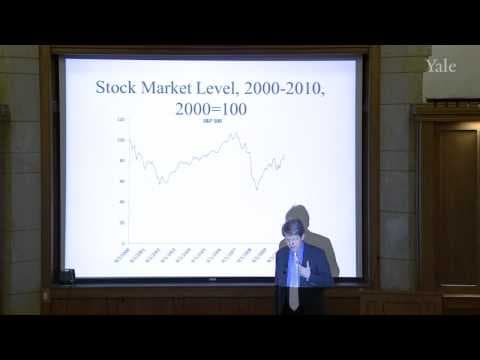
This lecture introduces probability theory, including expected value, variance, and covariance, within the context of the 2007-2008 financial crisis. Professor Shiller analyzes the impact of independence assumptions on Value at Risk and distinguishes between idiosyncratic and systematic risk using regression analysis. The session concludes with a discussion of fat-tailed distributions in financial returns.
3. Technology and Invention in Finance
Professor Shiller reviews probability theory and the Central Limit Theorem, then examines the societal role of financial innovation. He analyzes inventions such as limited liability, inflation indexation, and the mechanics of swap contracts and credit default swaps.
4. Portfolio Diversification and Supporting Financial Institutions
This lecture introduces mean-variance portfolio analysis, detailing Harry Markowitz's contributions and the derivation of the Efficient Portfolio Frontier and Mutual Fund Theorem. It culminates in an exposition of the Capital Asset Pricing Model (CAPM) and discusses the equity premium puzzle.
5. Insurance, the Archetypal Risk Management Institution, its Opportunities and Vulnerabilities
Professor Robert Shiller introduces insurance as a fundamental risk pooling mechanism, detailing issues such as moral hazard and selection bias. He analyzes the historical trajectory and bailout of AIG, the regulatory framework including the McCarran-Ferguson Act, and the implications of the Dodd-Frank bill on the industry. The lecture concludes with a discussion of catastrophic risk.
6. Guest Speaker David Swensen
David Swensen discusses his influential model for endowment management, addressing asset allocation, market timing, and security selection strategies. The lecture also examines external criticisms of the Swensen approach.
7. Efficient Markets
This lecture examines the Efficient Markets Hypothesis, its historical development, and empirical tests, contrasting it with phenomena like the Sharpe Ratio's manipulability and the Head and Shoulders pattern in technical analysis. It also differentiates stock price modeling via Random Walk versus a First-Order Autoregressive Process.
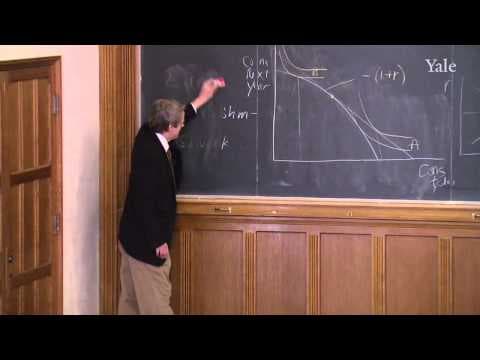
8. Theory of Debt, Its Proper Role, Leverage Cycles
This lecture examines the theoretical determinants of interest rates, drawing upon the work of Eugen von Boehm-Bawerk and Irving Fisher. It then derives bond pricing based on present discounted values and explores the expectations theory of the term structure of interest rates, concluding with a historical overview of usury.
Lecture 9: Corporate Stocks (ECON 252)
This lecture examines corporate structure, shareholder roles, and equity financing mechanisms like market capitalization and dividends, drawing on World Bank data. It contrasts for-profit and nonprofit corporate models.
Lecture 10: Real Estate (ECON 252)
Explore the evolution of mortgage financing and property rights, distinguishing short-term balloon payments from long-term amortizing mortgages. The lecture covers modern real estate investment trusts and securitization.
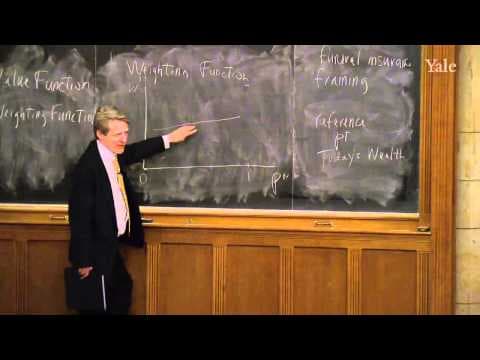
Lecture 11: Behavioral Finance and the Role of Psychology (ECON 252)
This lecture delves into behavioral finance, critically examining human biases in economic decision-making. It introduces Daniel Kahneman and Amos Tversky's Prospect Theory, detailing its value and probability weighting functions.
Lecture 12: Misbehavior, Crises, Regulation and Self Regulation (ECON 252)
The lecture outlines five levels of financial regulation, from firm-level governance to international accords. It discusses the fiduciary duties of boards of directors and the historical development of institutions like the NYSE.
Lecture 13: Banks (ECON 252)
Tracing the history of banking from ancient Sumeria to Renaissance Italy, this lecture analyzes banks' role in solving adverse selection and moral hazard. It also presents the Diamond-Dybvig model of bank runs.
Lecture 14: Guest Speaker Maurice "Hank" Greenberg (ECON 252)
Maurice "Hank" Greenberg, former AIG CEO, discusses building AIG through global diversification and innovative insurance products. He shares insights on leadership, market strategy, and the company's unique corporate culture.
15. Forward and Futures Markets
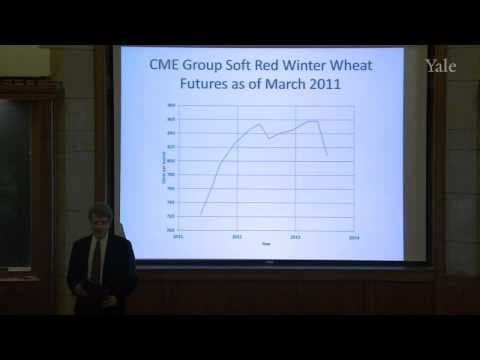
To begin the lecture, Professor Shiller elaborates on the difference between forwards and futures and on the role of futures markets to infer future prices for the underlying commodity or financial asset.
Lecture 16: Guest Speaker Laura Cha (ECON 252)
Laura Cha, former Vice Chair of the China Securities Regulatory Commission, shares her career trajectory and insights into financial market regulation. She emphasizes public service's impact on market creation and function.
Lecture 17: Options Markets (ECON 252)
This lecture introduces options fundamentals, graphically representing call and put option values, and deriving the put-call parity. It then presents the Binomial Asset Pricing Model and the Black-Scholes formula for option valuation.
Lecture 18: Monetary Policy (ECON 252)
The lecture traces the origins of central banking from the Bank of England to the Federal Reserve System. It examines the mechanisms of monetary policy, focusing on the federal funds rate and quantitative easing.
Lecture 19: Investment Banks (ECON 252)
This lecture defines investment banking by contrasting it with commercial banking and trading. It examines John Whitehead's principles of investment banking and discusses the societal influence and regulation of these institutions.
Lecture 20: Professional Money Managers and their Influence (ECON 252)
This lecture analyzes the crucial role of institutional investors and fiduciary duties, including the "prudent person rule." It explores various forms of institutional money management, such as mutual funds and pension funds.
Lecture 21: Exchanges, Brokers, Dealers, Clearinghouses (ECON 252)
This lecture differentiates between brokers and dealers, charting the history of securities exchanges from ancient Rome to the NYSE. It details trading mechanics using a limit order book and the role of clearinghouses.
Lecture 22: Public and Non-Profit Finance (ECON 252)
The lecture explores financial structures supporting public and nonprofit causes, illustrating how they achieve social missions. It examines the blurred lines between for-profit and public enterprises, and state and local finance.