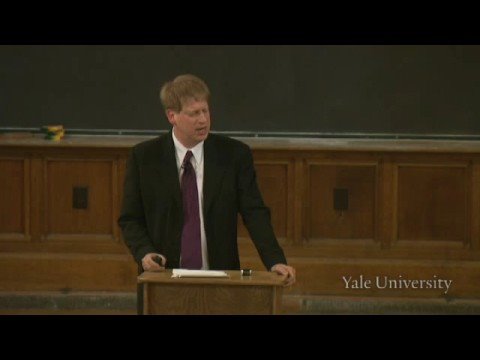
Opening How Do We Communicate?: Language in the Brain, Mouth
How Do We Communicate?: Language in the Brain, Mouth
- Length
- 57 min
- Level
- Undergraduate
- Recorded
- Yale University2008
Opening How Do We Communicate?: Language in the Brain, Mouth
Chapter 1 of 8: The scientific study of language
Bloom treats language as an instinct, citing creoles that grow from pidgins in a single generation as evidence.
Human language, in Paul Bloom's session 6 of Yale's PSYC 110, is treated as a combinatorial system governed by unconscious rules and grounded in biology. Bloom starts from Darwin's claim of an instinct to speak and Descartes's argument that language sets humans apart from machines. He then works through phonology, top-down processing in speech segmentation, the arbitrary sound–meaning pairings of morphemes, and recursive rules giving syntax infinite reach from a finite vocabulary. Creoles arising from pidgins within a single generation serve as evidence for linguistic universals. The last part follows Chomsky's view of acquisition as growth without correction, and traces infants' loss of sensitivity to foreign phonemes and a critical period closing near puberty. The material is pitched at beginning undergraduates.
Human language, in Paul Bloom's session 6 of Yale's PSYC 110, is treated as a combinatorial system governed by unconscious rules and grounded in biology. Bloom starts from Darwin's claim of an instinct to speak and Descartes's argument that language sets humans apart from machines. He then works through phonology, top-down processing in speech segmentation, the arbitrary sound–meaning pairings of morphemes, and recursive rules giving syntax infinite reach from a finite vocabulary. Creoles arising from pidgins within a single generation serve as evidence for linguistic universals. The last part follows Chomsky's view of acquisition as growth without correction, and traces infants' loss of sensitivity to foreign phonemes and a critical period closing near puberty. The material is pitched at beginning undergraduates.
The Language Instinct
Study by Brown and Hanlin
This lecture
Lecture 3 of 6 of Introduction to Psychology.
Choose a node to see how it connects to this lecture. What comes before is on the leftat the top. What comes after is on the rightat the bottom. The ring is what it teaches. People and places are above. Other lectures and books are below.
Press a chosen node again to open it.
Your comment is kept while you sign up.Sign in


