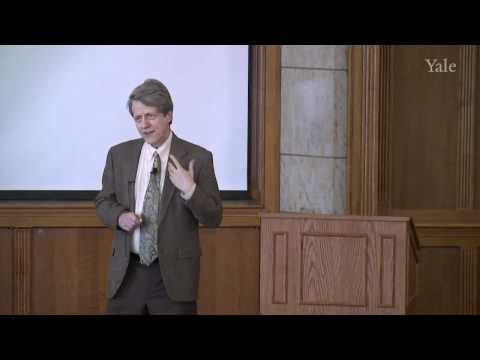
7. Efficient Markets

This lecture examines the Efficient Markets Hypothesis, its historical development, and empirical tests, contrasting it with phenomena like the Sharpe Ratio's manipulability and the Head and Shoulders pattern in technical analysis. It also differentiates stock price modeling via Random Walk versus a First-Order Autoregressive Process.
Financial Markets (2011) (ECON 252)
Initially, Professor Shiller looks back at David Swensen's guest lecture, in particular with respect to the Sharpe ratio as a performance measure for investment strategies. He emphasizes the empirical difficulty to measure the standard deviation, specifically for illiquid asset classes, and elaborates on investment strategies that manipulate the Sharpe ratio. Subsequently, he focuses on the Efficient Markets Hypothesis. This theory states that markets efficiently incorporate all public information, which consequently renders beating the market impossible. For example, technical analysis fails to provide powerful, short-run profit opportunities. A consequence of the Efficient Markets Hypothesis is that stock prices follow a Random Walk, as innovations to the stock price must be solely attributable to news. Professor Shiller contrasts the behavior of a Random Walk with that of a First-Order Autoregressive Process, and concludes that the latter statistical process matches the reality of the stock market more closely. This conclusion, combined with the evidence that investment managers like David Swensen are capable of consistently outperforming the market leads Professor Shiller to the conclusion that the Efficient Markets Hypothesis is a half-truth.
6. Guest Speaker David Swensen
Next · Lecture 88. Theory of Debt, Its Proper Role, Leverage Cycles
Seminar notes & discussion
No public seminar notes on this lecture yet.