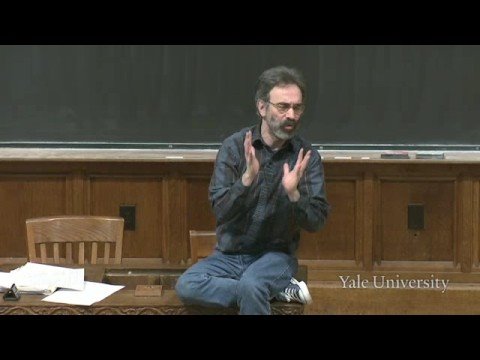
Opening A History of Philosophy: Spinoza (continued) and Leibniz
A History of Philosophy: Spinoza (continued) and Leibniz
- Length
- 1 h 8 min
- Level
- Undergraduate
- Recorded
- Wheaton College2015
Opening A History of Philosophy: Spinoza (continued) and Leibniz
Chapter 1 of 8: Spinoza on reason and emotion
Finishes Spinoza's account of emotion and bondage, then builds Leibniz's hierarchy of monads as units of force.
Gottfried Wilhelm Leibniz's monadology emerges as a teleological alternative to mechanistic science and Baruch Spinoza's determinism. The lecture contrasts Descartes, Spinoza, and Leibniz across the one-and-many problem, the mind-body relation, and determinism. Leibniz rejects mechanistic accounts of inert matter in favor of energetistic physics and relative space-time. Reality consists of monads, which are units of force structured in a hierarchy ranging from bare monads to the supreme monad.
Gottfried Wilhelm Leibniz's monadology emerges as a teleological alternative to mechanistic science and Baruch Spinoza's determinism. The lecture contrasts Descartes, Spinoza, and Leibniz across the one-and-many problem, the mind-body relation, and determinism. Leibniz rejects mechanistic accounts of inert matter in favor of energetistic physics and relative space-time. Reality consists of monads, which are units of force structured in a hierarchy ranging from bare monads to the supreme monad.
Ethics
Human Bondage and Human Freedom
Shema Yisrael
Spinoza's Ethics

This lecture
Lecture 38 of 81 of A History of Western Philosophy.
Choose a node to see how it connects to this lecture. What comes before is on the leftat the top. What comes after is on the rightat the bottom. The ring is what it teaches. People and places are above. Other lectures and books are below.
Press a chosen node again to open it.
Your comment is kept while you sign up.Sign in