Opening Cancer Biology: Cellular Barriers and Metastasis
Cancer Biology: Cellular Barriers and Metastasis
- Length
- 49 min
- Level
- Introductory
- Recorded
- MIT2020
Opening Cancer Biology: Cellular Barriers and Metastasis
Chapter 1 of 5: Before the lecture
Traces a carcinoma cell from lost E-cadherin junctions to the actin polymerization that drives it forward.
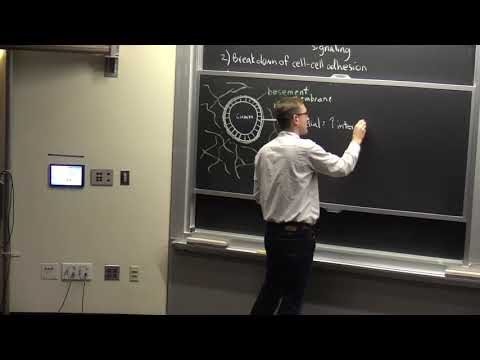
Metastasis in carcinomas depends on cancer cells breaking down the barriers that normally hold epithelial tissue in place. Martin starts from those barriers: apoptosis, dependence on growth and survival signals, and an architecture of basement membranes and E-cadherin junctions. He then shows how oncogenic mutations hyperactivate growth pathways and how loss of tumor suppressors lets cells evade apoptosis. The epithelial-to-mesenchymal transition, traced back to the discovery of Twist in Drosophila embryos, appears as a reversible gene-expression program that cancer cells borrow to lower adhesion. The final part explains how polarized actin polymerization at the leading edge pushes the membrane forward, illustrated with a neutrophil chasing a bacterium. Session 26 of MIT 7.016 assumes introductory biology and basic knowledge of the cytoskeleton.
Metastasis in carcinomas depends on cancer cells breaking down the barriers that normally hold epithelial tissue in place. Martin starts from those barriers: apoptosis, dependence on growth and survival signals, and an architecture of basement membranes and E-cadherin junctions. He then shows how oncogenic mutations hyperactivate growth pathways and how loss of tumor suppressors lets cells evade apoptosis. The epithelial-to-mesenchymal transition, traced back to the discovery of Twist in Drosophila embryos, appears as a reversible gene-expression program that cancer cells borrow to lower adhesion. The final part explains how polarized actin polymerization at the leading edge pushes the membrane forward, illustrated with a neutrophil chasing a bacterium. Session 26 of MIT 7.016 assumes introductory biology and basic knowledge of the cytoskeleton.
The Biology of Cancer
Molecular Biology of the Cell
Development
Svitkina et al. 1997. JCB
Molecular Cell Biology
Rapid leukocyte migration by integrin-independent flowing and squeezing
This lecture
Lecture 26 of 35 of Introductory Biology.
Choose a node to see how it connects to this lecture. What comes before is on the leftat the top. What comes after is on the rightat the bottom. The ring is what it teaches. People and places are above.
Press a chosen node again to open it.
Your comment is kept while you sign up.Sign in
Non-adherent cell type study