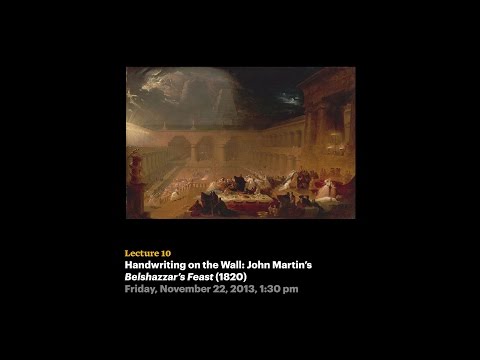
Opening Handwriting on the Wall: John Martin's Belshazzar's Feast
Handwriting on the Wall: John Martin's Belshazzar's Feast
- Length
- 1 h
- Level
- Undergraduate
- Recorded
- Yale University2014
Opening Handwriting on the Wall: John Martin's Belshazzar's Feast
Chapter 1 of 10: Before the lecture
John Martin's Belshazzar's Feast examines a monumental 1821 painting depicting the biblical downfall of the Babylonian king amidst extravagant architectural fantasies. The analysis explores how Martin combined high-drama narrative with pioneering visual exhibition techniques, mass-market printmaking, and early nineteenth-century mass entertainment spectacles. Through close comparisons with works by J.M.W. Turner, Washington Allston, and Rembrandt, the lecture traces the evolution of the romantic sublime in British art. It concludes by considering the painting's enduring influence on later visual culture, including historical fiction, theater, and early Hollywood cinema.

Your comment is kept while you sign up.Sign in
Analyzes John Martin's painting Belshazzar's Feast and its impact on nineteenth-century visual spectacle.
John Martin's Belshazzar's Feast examines a monumental 1821 painting depicting the biblical downfall of the Babylonian king amidst extravagant architectural fantasies. The analysis explores how Martin combined high-drama narrative with pioneering visual exhibition techniques, mass-market printmaking, and early nineteenth-century mass entertainment spectacles. Through close comparisons with works by J.M.W. Turner, Washington Allston, and Rembrandt, the lecture traces the evolution of the romantic sublime in British art. It concludes by considering the painting's enduring influence on later visual culture, including historical fiction, theater, and early Hollywood cinema.
Book of Daniel
The Last Days of Pompeii
Book of Revelation
Second Memoir on Babylon
Intolerance
This lecture
Lecture 10 of 12 of Let This Be A Lesson.
Choose a node to see how it connects to this lecture. What comes before is on the leftat the top. What comes after is on the rightat the bottom. The ring is what it teaches. People and places are above. Other lectures and books are below.
Press a chosen node again to open it.