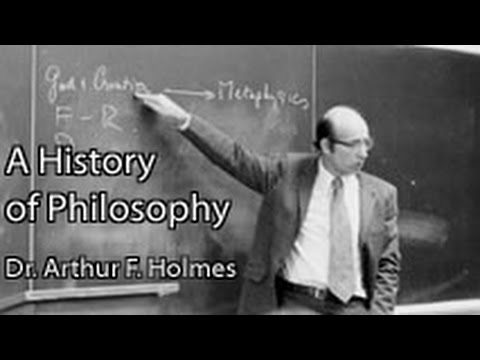
Opening Hegel's Phenomenology of Mind (A History of Philosophy, Lecture 58)
Hegel's Phenomenology of Mind (A History of Philosophy, Lecture 58)
- Length
- 1 h 1 min
- Level
- Undergraduate
- Recorded
- Wheaton College2015
Opening Hegel's Phenomenology of Mind (A History of Philosophy, Lecture 58)
Chapter 1 of 8: Hegel versus linear thinking
Holmes reads the master-servant relationship as Hegel's case that self-consciousness arises only through another.
Hegel's Phenomenology of Mind replaces Kant's linear, deductive reasoning with a dialectic that thinks concepts through their polarities. Holmes, in session 58 of his Wheaton College history of Western philosophy, starts from being and nonbeing resolving into becoming. He then presents spirit as a process of emerging consciousness rather than a substance. Subjective spirit runs from sense consciousness to the master-servant relationship, where self-consciousness depends on the other. Objective spirit moves from abstract law and individual conscience to social ethics, the sovereign constitutional state, and 19th-century nationalism. Some familiarity with Kant and German Idealism is assumed.
Hegel's Phenomenology of Mind replaces Kant's linear, deductive reasoning with a dialectic that thinks concepts through their polarities. Holmes, in session 58 of his Wheaton College history of Western philosophy, starts from being and nonbeing resolving into becoming. He then presents spirit as a process of emerging consciousness rather than a substance. Subjective spirit runs from sense consciousness to the master-servant relationship, where self-consciousness depends on the other. Objective spirit moves from abstract law and individual conscience to social ethics, the sovereign constitutional state, and 19th-century nationalism. Some familiarity with Kant and German Idealism is assumed.
Process and Reality
History and Truth in Hegel's Phenomenology of Mind
Hegel's Philosophy of Religion
History & Truth in Hegel's Phenomenology
Descartes's Faux pas
Robinson Crusoe
My Station and Its Duties

This lecture
Lecture 58 of 81 of A History of Western Philosophy.
Choose a node to see how it connects to this lecture. What comes before is on the leftat the top. What comes after is on the rightat the bottom. The ring is what it teaches. People and places are above. Other lectures and books are below.
Press a chosen node again to open it.
Your comment is kept while you sign up.Sign in
The Charge of the Light Brigade