Orbital Correction and Plum-Pudding Molecules

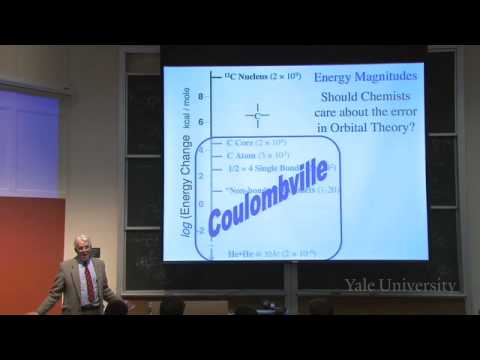
This session introduces orbital correction methods like 'Z-effective' and 'Self Consistent Field' to account for electron repulsion (correlation energy). It then utilizes a 'Plum-Pudding' model to rationalize molecular orbital forms, drawing parallels between CH4 and NH3 molecular orbitals and neon atomic orbitals.
Freshman Organic Chemistry (CHEM 125)
The lecture opens with tricks ("Z-effective" and "Self Consistent Field") that allow one to correct approximately for the error in using orbitals that is due to electron repulsion. This error is hidden by naming it "correlation energy." Professor McBride introduces molecules by modifying J.J. Thomson's Plum-Pudding model of the atom to rationalize the form of molecular orbitals. There is a close analogy in form between the molecular orbitals of CH4 and NH3 and the atomic orbitals of neon, which has the same number of protons and neutrons. The underlying form due to kinetic energy is distorted by pulling protons out of the Ne nucleus to play the role of H atoms.
Reality and the Orbital Approximation
Next · Lecture 12Overlap and Atom-Pair Bonds