
Freshman Organic Chemistry I
Grounds organic chemistry in quantum mechanics and experimental history—from force laws, wavefunctions, and X-ray diffraction to stereochemistry, conformational strain, and reaction mechanisms.
Syllabus
22How Do You Know?
This inaugural lecture for Yale's Freshman Organic Chemistry critically examines the question "How do you know?" by contrasting divine and human authority with experiment and logic, referencing Francis Bacon's Instauration and Isaac Newton's crucial experiments on light. It introduces foundational concepts of chemical bonding and Hooke's Law.
Force Laws, Lewis Structures and Resonance
This lecture investigates the quest for a chemical force law, contrasting Hooke's and Coulomb's laws with the Morse potential. It then introduces G. N. Lewis's shared-pair model, Lewis-dot notation, and the concept of resonance to describe molecular structure and reactivity.
Double Minima, Earnshaw's Theorem and Plum-Puddings
This lecture explores the structural equilibrium of molecules like ozone using double-well potentials. It then elucidates Earnshaw's Theorem regarding the instability of electrostatic equilibria and examines J. J. Thomson's plum-pudding atomic model.
Coping with Smallness and Scanning Probe Microscopy
This lecture critiques early attempts at atomic visualization by charlatans, then examines experiments by Newton and Franklin for measuring small distances. It concludes by detailing the principles and applications of Scanning Probe Microscopy for probing individual molecules and atoms.
X-Ray Diffraction
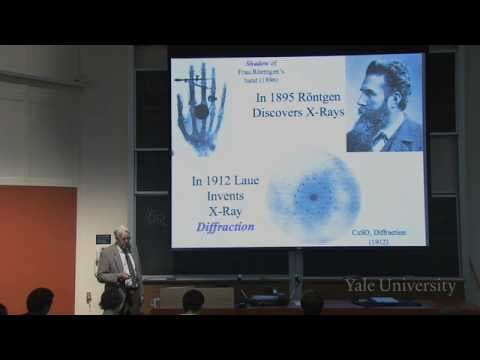
Professor McBride elucidates the principles of X-ray diffraction, demonstrating how the scattering of light by charged particles reveals electron distribution in molecules. The lecture uses laser diffraction masks to illustrate crystal lattice effects, applying these concepts to the structural analysis of compounds such as benzene.
Seeing Bonds by Electron Difference Density
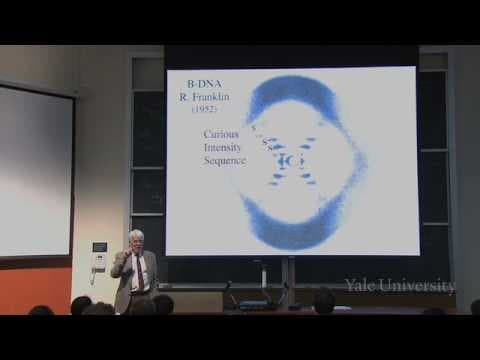
Professor McBride elucidates the principles of X-ray crystallography, correlating diffraction patterns to electron distribution in molecules. The lecture details the use of electron difference density maps to visualize chemical bonds and unshared electron pairs, critically examining their observed density compared to theoretical models.
Quantum Mechanical Kinetic Energy
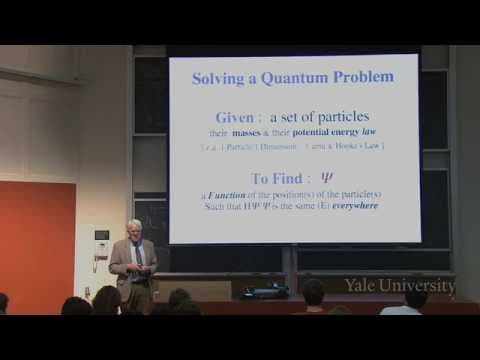
This lecture transitions from the limitations of Lewis bonding theory to the fundamentals of quantum mechanics, interpreting the wave function ψ and its role in determining kinetic energy via the Schrödinger equation. It explores the concept of negative kinetic energy based on the curvature of ψ.
One-Dimensional Wave Functions
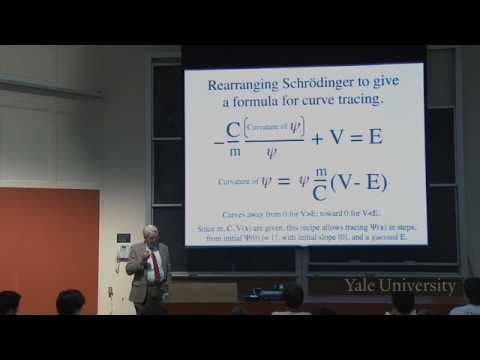
This lecture explores the curvature of wave functions as it relates to kinetic energy and electron probability density, demonstrating how non-divergence mandates quantized energy levels for harmonic oscillator, Morse, and Coulombic potentials. It further examines the 'isotope effect' on bond dynamics and energy.
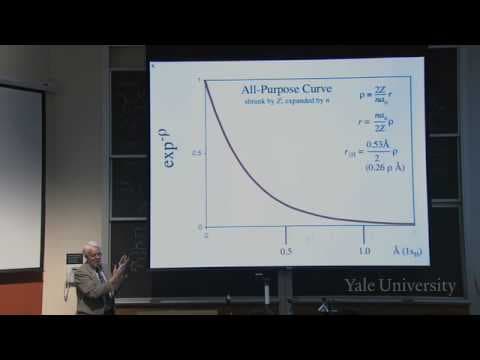
Chladni Figures and One-Electron Atoms
Professor McBride discusses multi-dimensional wave functions by drawing an analogy between acoustical Chladni figures and the nodal patterns of Schrödinger's three-dimensional equation. This provides a framework for understanding the simplified forms of wave functions in hydrogen-like one-electron atoms.
Reality and the Orbital Approximation
This lecture examines the impact of increased nuclear charge on one-electron atom energies and introduces orbital hybridization. It critically addresses the limitations of describing multi-electron systems using one-electron orbital approximations.
Orbital Correction and Plum-Pudding Molecules
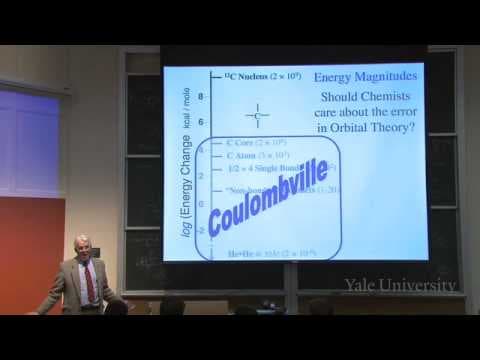
This session introduces orbital correction methods like 'Z-effective' and 'Self Consistent Field' to account for electron repulsion (correlation energy). It then utilizes a 'Plum-Pudding' model to rationalize molecular orbital forms, drawing parallels between CH4 and NH3 molecular orbitals and neon atomic orbitals.
Overlap and Atom-Pair Bonds
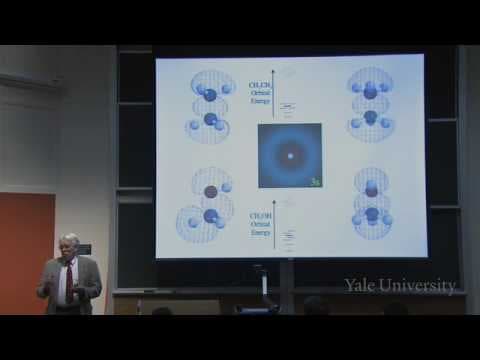
This lecture begins by applying the united-atom "plum-pudding" view of molecular orbitals, introduced in the previous lecture, to more complex molecules.
Overlap and Energy-Match
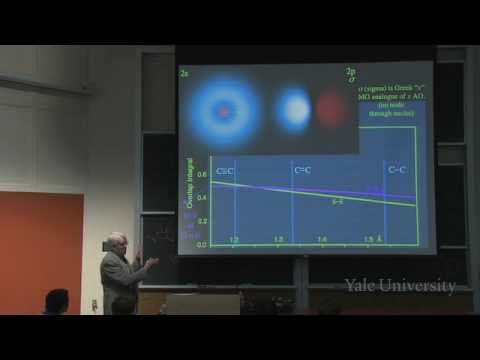
Professor McBride demonstrates that covalent bonding fundamentally relies on orbital overlap and energy-match, detailing how hybridization influences overlap and the number of shared electrons affects bond strength. Experimental data from H-H and H-F heterolysis/homolysis confirm these quantum mechanical predictions.
Checking Hybridization Theory with XH_3
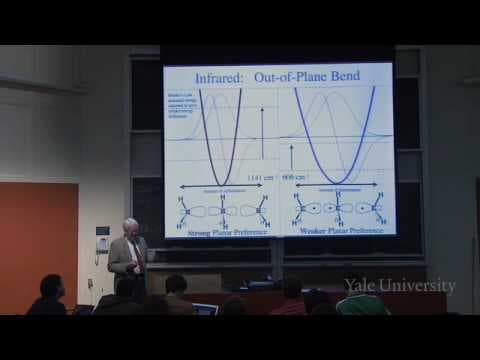
This lecture scrutinizes hybridization theory by examining the central atom in XH3 molecules, linking hybridization to molecular structure via the constraint of non-overlapping electron pairs. It utilizes the 'Umbrella Vibration' and rehybridization to illustrate the competition between strong bonds and stable atoms, validated by infrared and ESR experiments.
Chemical Reactivity: SOMO, HOMO, and LUMO
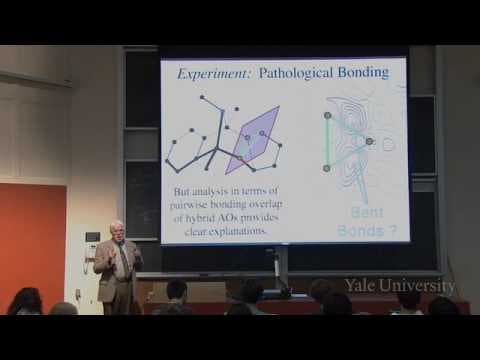
This lecture contrasts localized bond models with total electron density and computational molecular orbitals. It then establishes the foundation for understanding chemical reactivity through the overlap of singly-occupied (SOMO), highest occupied (HOMO), and lowest unoccupied (LUMO) molecular orbitals, generalizing acid-base concepts.
Recognizing Functional Groups
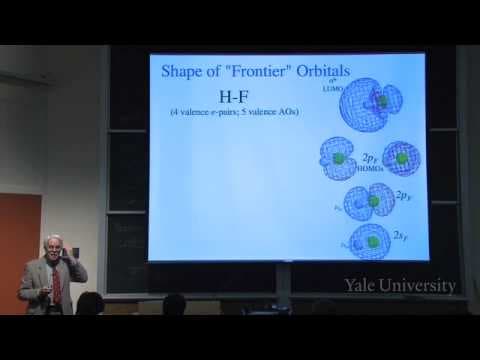
This lecture continues the HOMO/LUMO discussion by identifying high-energy HOMOs (basic) and low-energy LUMOs (acidic), exemplified with BH3 dimerization and the acidity of HF and CH3F. It differentiates between MO nodes from atomic orbitals (AON) and antibonding nodes (ABN) in reaction mechanisms.
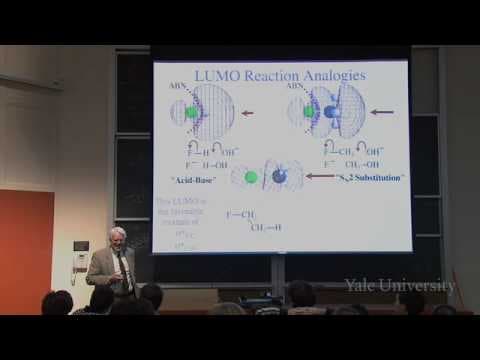
Reaction Analogies and Carbonyl Reactivity
This lecture draws parallels between acid-base, SN2, and E2 reactions, all involving bond breaking at antibonding LUMOs and new bond formation. It analyzes ammonia oxidation and carbonyl reactivity, predicting the Bürgi-Dunitz trajectory for nucleophilic attack, validated by X-ray diffraction data.
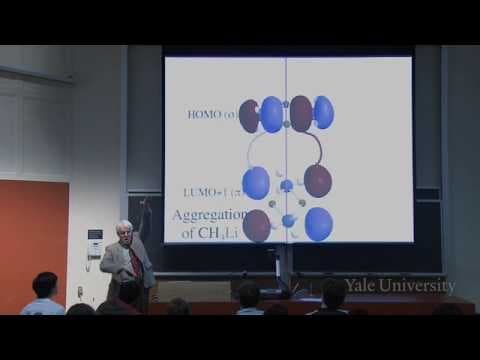
Amide, Carboxylic Acid and Alkyl Lithium
This lecture analyzes the properties of amides, carboxylic acids, and alkyllithiums through localized atomic and pairwise orbital interactions, specifically exploring 'resonance' in amides, the acidity of carboxylic acids, and the aggregation of methyl lithium. It highlights the predictive power of traditional organic chemistry tools.
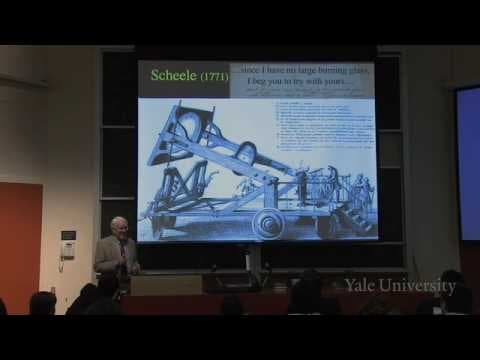
Oxygen and the Chemical Revolution (Beginning to 1789)
This lecture inaugurates a historical survey of organic chemistry, beginning with Lavoisier's 'Chemical Revolution'. It covers early discoveries like Scheele's isolation of oxygen and organic acids, emphasizing Lavoisier's systematic approach to facts, ideas, and nomenclature based on quantitative measurements.
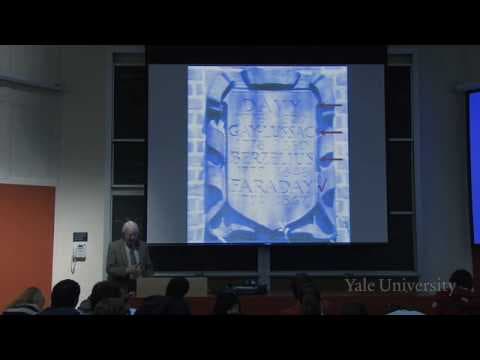
Rise of the Atomic Theory (1790-1805)
This lecture explores the historical development of atomic theory, detailing Lavoisier's foundational experiments in elemental analysis, John Dalton's empirical laws of definite and multiple proportions, and Berzelius's contributions to precise analytical methods.
Berzelius to Liebig and Wöhler (1805-1832)
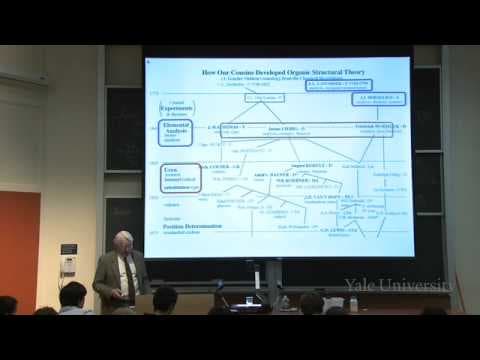
This lecture traces key developments from Berzelius's elemental discoveries and combustion analysis to the dualism theory of electrostatic attraction. It highlights Wöhler's synthesis of urea revealing isomerism and the collaborative work of Wöhler and Liebig on oil of bitter almonds, extending dualism into organic chemistry through radical theory.
Radical and Type Theories (1832-1850)
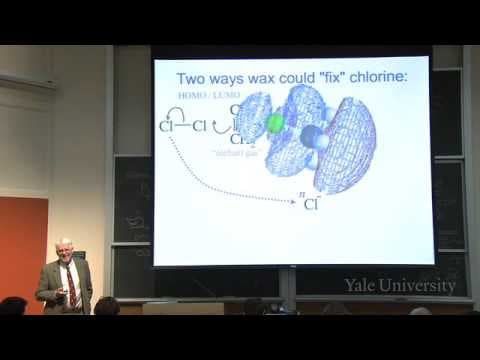
This lecture examines the competing radical and type theories of organic chemistry, inspired by Wöhler and Liebig's work on benzaldehyde. It discusses Dumas's advocacy for type theory to accommodate substitution reactions and introduces HOMO-LUMO and SOMO mechanisms for alkene additions and free-radical chain reactions, respectively.