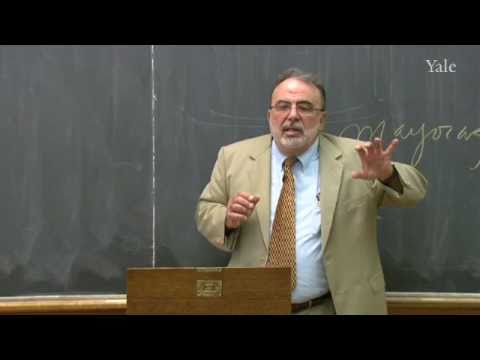
Opening Leibniz on Evil (A History of Philosophy, Lecture 40)
Leibniz on Evil (A History of Philosophy, Lecture 40)
- Length
- 59 min
- Level
- Undergraduate
- Recorded
- Wheaton College2015
Opening Leibniz on Evil (A History of Philosophy, Lecture 40)
Chapter 1 of 8: Freedom and determinism in Leibniz
Examines Gottfried Wilhelm Leibniz's philosophical treatment of the problem of evil and human freedom.
Gottfried Wilhelm Leibniz addresses the problem of evil through the concept of the best of all possible worlds. The lecture contrasts Leibniz's teleological monadology with the deterministic materialism of Hobbes and the indeterminist dualism of Descartes. It builds an argument connecting pre-established harmony, human freedom, and divine foreknowledge to the problem of evil. The discussion explores the greater good argument and the distinction between moral and metaphysical necessity. It concludes with the eschatological trajectory toward the city of God.
Gottfried Wilhelm Leibniz addresses the problem of evil through the concept of the best of all possible worlds. The lecture contrasts Leibniz's teleological monadology with the deterministic materialism of Hobbes and the indeterminist dualism of Descartes. It builds an argument connecting pre-established harmony, human freedom, and divine foreknowledge to the problem of evil. The discussion explores the greater good argument and the distinction between moral and metaphysical necessity. It concludes with the eschatological trajectory toward the city of God.
Theodicy
Theodicy anthology
Discourse on Metaphysics
Monadology
First Truths
Little Metaphysics Book
Metaphysics book

This lecture
Lecture 40 of 81 of A History of Western Philosophy.
Choose a node to see how it connects to this lecture. What comes before is on the leftat the top. What comes after is on the rightat the bottom. The ring is what it teaches. People and places are above. Other lectures and books are below.
Press a chosen node again to open it.
Your comment is kept while you sign up.Sign in
Candide