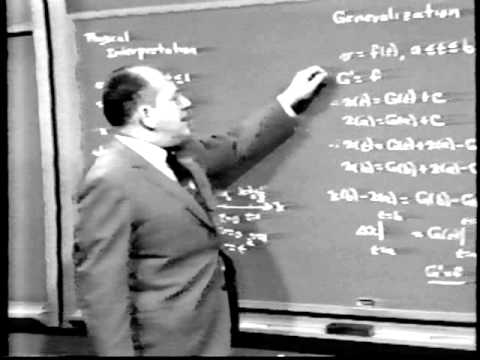
Opening Marriage of Differential and Integral Calculus
Marriage of Differential and Integral Calculus
- Length
- 31 min
- Level
- Undergraduate
- Recorded
- MIT2011
Opening Marriage of Differential and Integral Calculus
Chapter 1 of 5: Before the lecture
The fundamental theorems of calculus link the rate of change of a function to the area accumulated under its curve. In session 22 of MIT Calculus Revisited, Herbert Gross bounds the change in area between an inscribed and a circumscribed rectangle. Taking the limit shows that the derivative of the area function equals the height of the curve. The first fundamental theorem follows: area comes from evaluating an inverse derivative at the endpoints. Gross then explains why definite integral notation denotes both a limit of sums and a difference of antiderivatives. The closing result is the second theorem, which builds an antiderivative for any continuous function from an integral.
Your comment is kept while you sign up.Sign in
Gross bounds area change between inscribed and circumscribed rectangles, deriving the curve's height as its rate.
The fundamental theorems of calculus link the rate of change of a function to the area accumulated under its curve. In session 22 of MIT Calculus Revisited, Herbert Gross bounds the change in area between an inscribed and a circumscribed rectangle. Taking the limit shows that the derivative of the area function equals the height of the curve. The first fundamental theorem follows: area comes from evaluating an inverse derivative at the endpoints. Gross then explains why definite integral notation denotes both a limit of sums and a difference of antiderivatives. The closing result is the second theorem, which builds an antiderivative for any continuous function from an integral.
This lecture
Lecture 22 of 38 of MIT Calculus Revisited: Single Variable Calculus.
Choose a node to see how it connects to this lecture. What comes before is on the leftat the top. What comes after is on the rightat the bottom. The ring is what it teaches. People and places are above. Other lectures and books are below.
Press a chosen node again to open it.