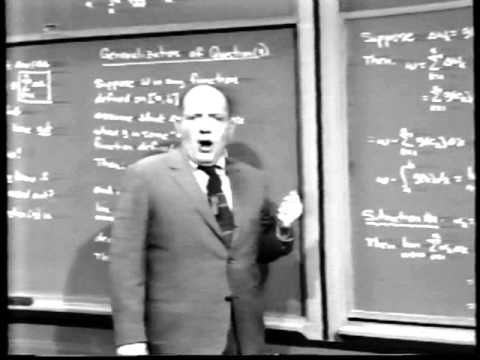
Opening Three-Dimensional Area
Three-Dimensional Area
- Length
- 42 min
- Level
- Undergraduate
- Recorded
- MIT2011
Opening Three-Dimensional Area
Chapter 1 of 7: Before the lecture
Volume in single-variable calculus can be built as three-dimensional area, with the cylinder as the basic building block defined by three axioms. In session 23 of MIT's Calculus Revisited, Herbert Gross derives the volume of a cone as a limit of stacked cylinders. He then recomputes it as a definite integral of cross-sectional area. Solids of revolution follow by integrating circular cross-sections of a continuous function rotated about an axis. Gross next develops cylindrical shells for rotations where the function is hard to invert, computing cones and parabolas both ways. Prerequisites are the definite integral, Riemann sums and the fundamental theorem of calculus.
Your comment is kept while you sign up.Sign in
Gross derives the volume of a cone twice, from stacked cylinders and from an integral, then checks shells against discs.
Volume in single-variable calculus can be built as three-dimensional area, with the cylinder as the basic building block defined by three axioms. In session 23 of MIT's Calculus Revisited, Herbert Gross derives the volume of a cone as a limit of stacked cylinders. He then recomputes it as a definite integral of cross-sectional area. Solids of revolution follow by integrating circular cross-sections of a continuous function rotated about an axis. Gross next develops cylindrical shells for rotations where the function is hard to invert, computing cones and parabolas both ways. Prerequisites are the definite integral, Riemann sums and the fundamental theorem of calculus.
This lecture
Lecture 23 of 38 of MIT Calculus Revisited: Single Variable Calculus.
Choose a node to see how it connects to this lecture. What comes before is on the leftat the top. What comes after is on the rightat the bottom. The ring is what it teaches. People and places are above.
Press a chosen node again to open it.