Opening Modelling a Resonance (MIT 8.04 Quantum Physics I)
Modelling a Resonance (MIT 8.04 Quantum Physics I)
- Length
- 16 min
- Level
- Undergraduate
- Recorded
- MIT2017
Opening Modelling a Resonance (MIT 8.04 Quantum Physics I)
Chapter 1 of 3: Mathematical model of a resonance
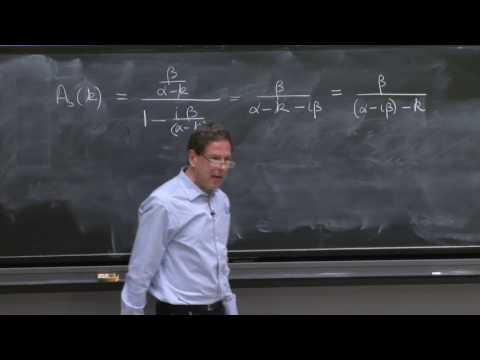
A scattering resonance shows up as a phase shift that climbs rapidly over a narrow range of momentum, and Zwiebach captures this with a simple arctangent model. The model has two parameters: fixes the position of the resonance and sets its width. After plotting the phase, Zwiebach computes its derivative at the resonance and finds the slope . Squaring the sine of the phase shift gives a symmetric peak, the Breit-Wigner distribution for the cross section. A linear approximation of momentum near recasts the peak in terms of energy, and is defined as the half-width at half maximum. The session is part of MIT 8.04 and assumes phase shifts and basic calculus.
Your comment is kept while you sign up.Sign in
Models a resonant phase shift as an arctangent in momentum, then squares its sine to obtain the Breit-Wigner peak.
A scattering resonance shows up as a phase shift that climbs rapidly over a narrow range of momentum, and Zwiebach captures this with a simple arctangent model. The model has two parameters: fixes the position of the resonance and sets its width. After plotting the phase, Zwiebach computes its derivative at the resonance and finds the slope . Squaring the sine of the phase shift gives a symmetric peak, the Breit-Wigner distribution for the cross section. A linear approximation of momentum near recasts the peak in terms of energy, and is defined as the half-width at half maximum. The session is part of MIT 8.04 and assumes phase shifts and basic calculus.
This lecture
Lecture 69 of 88 of Quantum Physics I.
Choose a node to see how it connects to this lecture. What comes before is on the leftat the top. What comes after is on the rightat the bottom. The ring is what it teaches. People and places are above. Other lectures and books are below.
Press a chosen node again to open it.