Opening Resonances in the Complex k-Plane (MIT 8.04 Quantum Physics I)
Resonances in the Complex k-Plane (MIT 8.04 Quantum Physics I)
- Length
- 15 min
- Level
- Undergraduate
- Recorded
- MIT2017
Opening Resonances in the Complex k-Plane (MIT 8.04 Quantum Physics I)
Chapter 1 of 3: Complex phase shifts
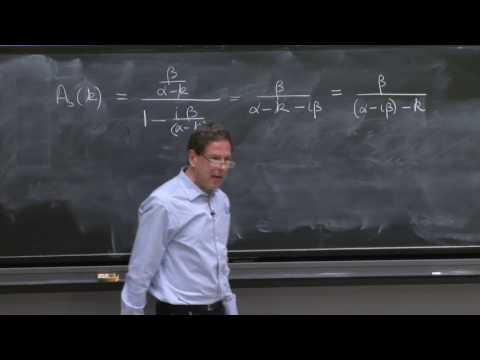
Resonances in one-dimensional quantum scattering appear as poles of the scattering amplitude once the wave number is allowed to take complex values. Zwiebach, teaching session 70 of MIT's Quantum Physics I, starts from complex phase shifts to explain why the amplitude grows large near a resonance. He then shows that the amplitude becomes infinite at points just below the real axis, which defines a resonance. Scattering states sit on the real axis, and bound states with negative energy sit on the positive imaginary axis. The session closes with anti-bound states, poles on the negative imaginary axis tied to purely growing exponential solutions.

Your comment is kept while you sign up.Sign in
Zwiebach locates resonances as poles of the scattering amplitude just below the real axis of the complex -plane.
Resonances in one-dimensional quantum scattering appear as poles of the scattering amplitude once the wave number is allowed to take complex values. Zwiebach, teaching session 70 of MIT's Quantum Physics I, starts from complex phase shifts to explain why the amplitude grows large near a resonance. He then shows that the amplitude becomes infinite at points just below the real axis, which defines a resonance. Scattering states sit on the real axis, and bound states with negative energy sit on the positive imaginary axis. The session closes with anti-bound states, poles on the negative imaginary axis tied to purely growing exponential solutions.
This lecture
Lecture 70 of 88 of Quantum Physics I.
Choose a node to see how it connects to this lecture. What comes before is on the leftat the top. What comes after is on the rightat the bottom. The ring is what it teaches. People and places are above. Other lectures and books are below.
Press a chosen node again to open it.