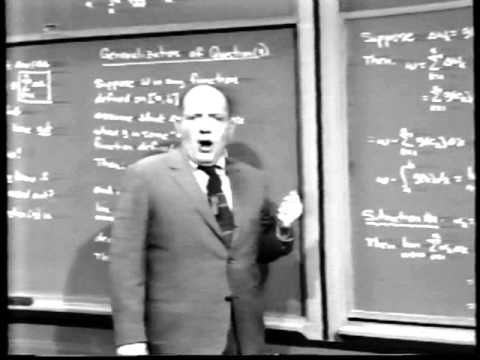
Opening One-Dimensional Area
One-Dimensional Area
- Length
- 37 min
- Level
- Undergraduate
- Recorded
- MIT2011
Opening One-Dimensional Area
Chapter 1 of 6: Before the lecture
Arc length, treated by Herbert Gross as one-dimensional area, resists the region-containment axioms that worked for area and volume, since a subset can have a greater perimeter than its superset. Gross first tries to mimic the area method by approximating each arc element with , and shows the sum returns only the length of the interval. Inscribed chords replace the increments, raising three questions: whether the limit exists, how to compute it, and what it means intuitively. The Mean Value Theorem turns each chord into a derivative term, giving when is continuous. A closing plausibility argument on the form shows the errors vanish as higher-order infinitesimals. The session assumes Riemann sums, derivatives and the Mean Value Theorem.
Your comment is kept while you sign up.Sign in
Gross shows why sums return only the interval, then builds arc length from inscribed chords.
Arc length, treated by Herbert Gross as one-dimensional area, resists the region-containment axioms that worked for area and volume, since a subset can have a greater perimeter than its superset. Gross first tries to mimic the area method by approximating each arc element with , and shows the sum returns only the length of the interval. Inscribed chords replace the increments, raising three questions: whether the limit exists, how to compute it, and what it means intuitively. The Mean Value Theorem turns each chord into a derivative term, giving ∫ₐᵇ √(1 + f'(x)²) dx when is continuous. A closing plausibility argument on the form shows the errors vanish as higher-order infinitesimals. The session assumes Riemann sums, derivatives and the Mean Value Theorem.
This lecture
Lecture 24 of 38 of MIT Calculus Revisited: Single Variable Calculus.
Choose a node to see how it connects to this lecture. What comes before is on the leftat the top. What comes after is on the rightat the bottom. The ring is what it teaches. People and places are above.
Press a chosen node again to open it.


