
Opening Ramsauer-Townsend Phenomenology (MIT 8.04 Quantum Physics I)
Ramsauer-Townsend Phenomenology (MIT 8.04 Quantum Physics I)
- Length
- 10 min
- Level
- Undergraduate
- Recorded
- MIT2017
Opening Ramsauer-Townsend Phenomenology (MIT 8.04 Quantum Physics I)
Chapter 1 of 2: Transmission coefficient of square wells
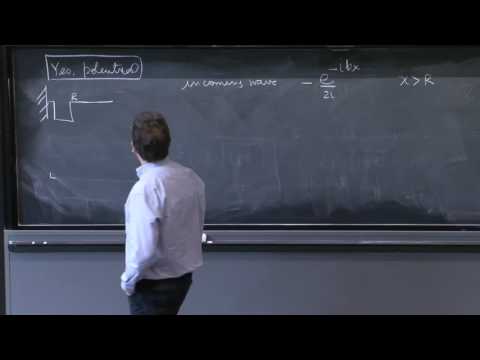
The Ramsauer-Townsend effect is the near-total transparency of rare gas atoms to electrons of about 1 eV. Zwiebach starts from the transmission coefficient of a square well, whose parameters set how transmission oscillates at positive energies. The plot shows transmission reaching one at specific energies, where resonance removes all reflection. He then turns to the 1921 elastic scattering experiments of Ramsauer and Townsend with low-energy electrons and rare gas atoms. A spherically symmetric atom with balanced nuclear and electronic charge acts as an attractive well, and resonant transmission explains the drop that classical collision models could not.
Your comment is kept while you sign up.Sign in
Plots the square-well transmission coefficient and uses its resonances to explain the 1921 Ramsauer-Townsend anomaly.
The Ramsauer-Townsend effect is the near-total transparency of rare gas atoms to electrons of about 1 eV. Zwiebach starts from the transmission coefficient of a square well, whose parameters set how transmission oscillates at positive energies. The plot shows transmission reaching one at specific energies, where resonance removes all reflection. He then turns to the 1921 elastic scattering experiments of Ramsauer and Townsend with low-energy electrons and rare gas atoms. A spherically symmetric atom with balanced nuclear and electronic charge acts as an attractive well, and resonant transmission explains the drop that classical collision models could not.
This lecture
Lecture 62 of 88 of Quantum Physics I.
Choose a node to see how it connects to this lecture. What comes before is on the leftat the top. What comes after is on the rightat the bottom. The ring is what it teaches. People and places are above. Other lectures and books are below.
Press a chosen node again to open it.


