Opening Scattering in One Dimension: Incoming and Outgoing Waves (MIT 8.04 Quantum Physics I)
Scattering in One Dimension: Incoming and Outgoing Waves (MIT 8.04 Quantum Physics I)
- Length
- 18 min
- Level
- Undergraduate
- Recorded
- MIT2017
Opening Scattering in One Dimension: Incoming and Outgoing Waves (MIT 8.04 Quantum Physics I)
Chapter 1 of 3: Scattering in one dimension
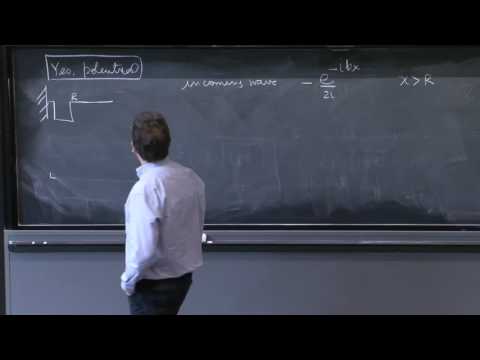
Scattering in one dimension starts from a system with an infinite barrier at and a finite potential of range . By first solving the free-particle case without a potential, the wave function is expressed as a combination of incoming and outgoing plane waves forming a sine function. When a potential is introduced, the wave function outside the range of the potential must preserve the probability current. Current conservation requires the magnitude of the incoming and outgoing coefficients to remain equal, which introduces a phase shift . This continuous phase shift contains the physical information about the unknown potential.

Your comment is kept while you sign up.Sign in
Derives the one-dimensional scattering wave function and phase shift from probability current conservation.
Scattering in one dimension starts from a system with an infinite barrier at and a finite potential of range . By first solving the free-particle case without a potential, the wave function is expressed as a combination of incoming and outgoing plane waves forming a sine function. When a potential is introduced, the wave function outside the range of the potential must preserve the probability current. Current conservation requires the magnitude of the incoming and outgoing coefficients to remain equal, which introduces a phase shift . This continuous phase shift contains the physical information about the unknown potential.
This lecture
Lecture 63 of 88 of Quantum Physics I.
Choose a node to see how it connects to this lecture. What comes before is on the leftat the top. What comes after is on the rightat the bottom. The ring is what it teaches. People and places are above. Other lectures and books are below.
Press a chosen node again to open it.


