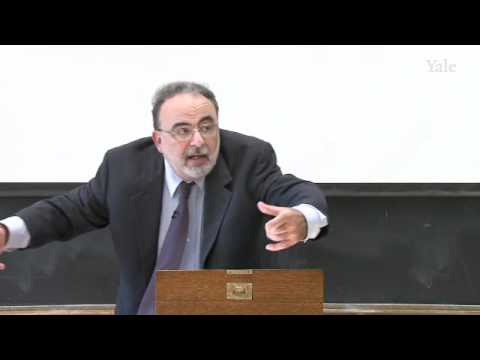
Opening Thomas Aquinas' Christian Aristotelianism (A History of Philosophy, Lecture 24)
Thomas Aquinas' Christian Aristotelianism (A History of Philosophy, Lecture 24)
- Length
- 41 min
- Level
- Undergraduate
- Recorded
- Wheaton College2015
Opening Thomas Aquinas' Christian Aristotelianism (A History of Philosophy, Lecture 24)
Chapter 1 of 6: Before the lecture
Thomas Aquinas synthesized Christian theology with Aristotelian metaphysics by modifying Greek philosophical categories to serve Christian doctrine. The lecture examines how Aquinas redefined creation as an absolute act of bringing beings from nothing, distinguishing prime matter as pure potential from substantial forms. It details his account of natural reason and its limits, contrasting the human image of God in rationality with the moral likeness lost in the fall. The discussion concludes by analyzing how Aquinas harmonized faith and reason against the Averroist theory of twofold truth.
Your comment is kept while you sign up.Sign in
Holmes shows how Aquinas bent Aristotle's matter, form and privation to fit creation out of nothing.
Thomas Aquinas synthesized Christian theology with Aristotelian metaphysics by modifying Greek philosophical categories to serve Christian doctrine. The lecture examines how Aquinas redefined creation as an absolute act of bringing beings from nothing, distinguishing prime matter as pure potential from substantial forms. It details his account of natural reason and its limits, contrasting the human image of God in rationality with the moral likeness lost in the fall. The discussion concludes by analyzing how Aquinas harmonized faith and reason against the Averroist theory of twofold truth.
The Principles of Nature
Principles of Nature
Aquinas and Calvin
This lecture
Lecture 24 of 81 of A History of Western Philosophy.
Choose a node to see how it connects to this lecture. What comes before is on the leftat the top. What comes after is on the rightat the bottom. The ring is what it teaches. People and places are above. Other lectures and books are below.
Press a chosen node again to open it.