
Simons Institute: Prediction, Incentives & Causal Intervention
Simons Institute FacultyInterdisciplinary research sequence at the interface of economics, causal inference, and algorithmic decision-making, studying performative prediction, strategic classification, and mechanism design.
Syllabus
18Triage Score: A Counterfactual Risk Assessment Instrument (SIMONS-ECON)
This lecture introduces "triage scores" as a counterfactual risk assessment instrument, addressing how intervention affects outcomes in high-stakes decision-making beyond mere prediction.
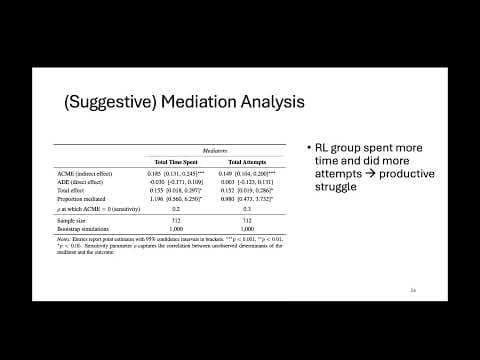
LLM-Guided Reinforcement Learning for Mastery Learning: Large-Scale Field Evidence (SIMONS-ECON)
This session presents a large-scale RCT on LLM-powered AI tutors, exploring personalized practice sequences using a POMDP framework for student mastery inference in Python certification.
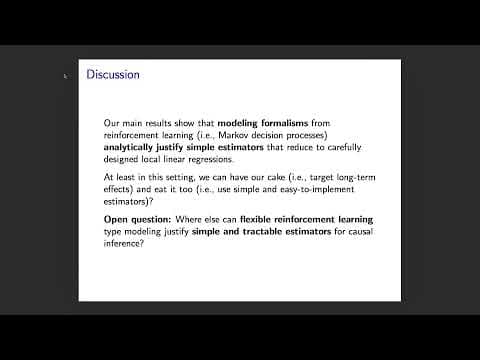
Non-parametric Causal Inference in Dynamic Thresholding Designs (SIMONS-ECON)
This talk examines non-parametric causal inference in dynamic thresholding designs, addressing the limitations of naive regression-discontinuity analysis when temporal dynamics are present.
Agreement and Alignment for Human-AI Collaborative Decision Making (SIMONS-ECON)
This lecture explores human-AI collaboration in decision-making, leveraging Aumann’s classical agreement theorem to understand how humans and AI models can achieve better outcomes together.
Human Values in Clinical Algorithms, Old and New (SIMONS-ECON)
This presentation discusses the embedding of human values in clinical algorithms, examining how both traditional equations and large language models influence diagnostic reasoning and management.

When Prediction Becomes Policy: What Do Risk Models Actually Learn? (SIMONS-ECON)
This lecture investigates how predictive risk models in child welfare, when acting as policy, learn "risk" from administrative records shaped by bureaucracy, resources, and discretionary judgment.
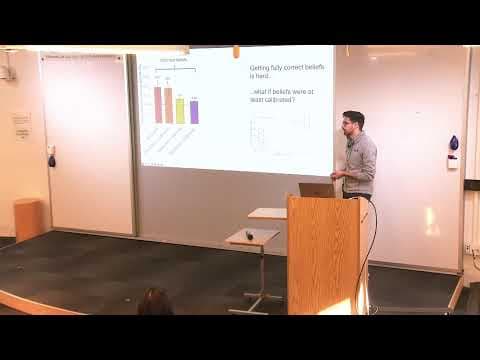
Evaluating Probabilistic Decision Making by LLMs: A Decision-Theoretic Framework and Application (SIMONS-ECON)
This session proposes a revealed-preference approach to evaluate probabilistic decision-making in large language models, applying a decision-theoretic framework to high-stakes applications like medical triage.
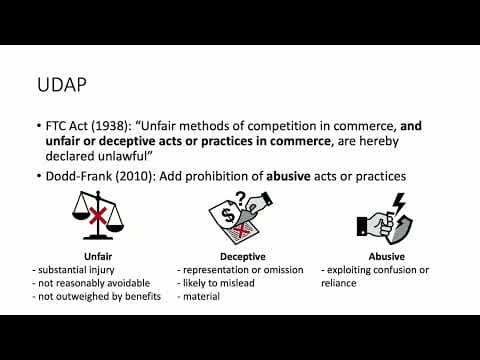
Algorithmic UDAP (SIMONS-ECON)
This talk compares disparate impact and UDAAP legal frameworks for evaluating algorithmic discrimination, formalizing their application in a simulated lending setting to assess harms.
Operational Dosage: The Impact of Capacity Constraints on RCT Evaluation (SIMONS-ECON)
This lecture analyzes RCTs evaluating service interventions under capacity constraints, using queueing theory to model "operational dosage" and its impact on treatment effect estimation.
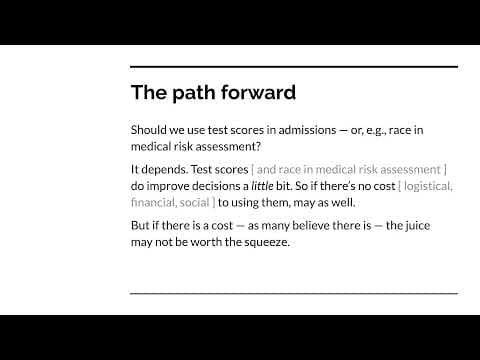
The Role of Standardized Tests in Admissions: Predictions vs. Decisions (SIMONS-ECON)
This talk revisits the debate on standardized tests in admissions by analyzing a dataset of master's program applications, finding GRE scores improve first-year grade predictions.
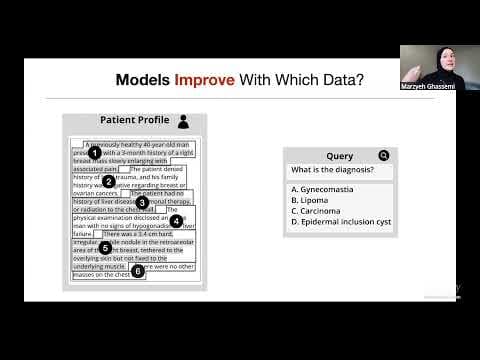
Individual Gaps in Prediction Generalization (SIMONS-ECON)
This lecture explores individual gaps in prediction generalization, focusing on challenges in applying predictive models universally across diverse populations or contexts.

Beyond Prediction Performance: How Modeling Decisions Shape Fairness Outcomes in Statistical Profiling (SIMONS-ECON)
This presentation examines how modeling decisions in statistical profiling impact fairness, analyzing regression and machine learning approaches using German labor market data.
The Feedback Loop of Statistical Discrimination (SIMONS-ECON)
This lecture introduces a dynamic model of firm-applicant interactions to identify mechanisms driving long-term statistical discrimination, highlighting the role of initial evaluation ability.
Decision Theoretic Foundations for Human-AI Collaboration (SIMONS-ECON)
This session discusses decision-theoretic foundations for human-AI collaboration, presenting measurement frameworks rooted in statistical decision theory and information economics for team performance evaluation.
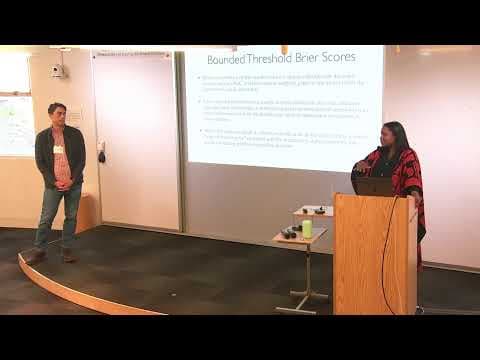
Evaluation Design (SIMONS-ECON)
This lecture delves into the principles and methodologies of evaluation design, focusing on critical considerations for assessing interventions in social systems.
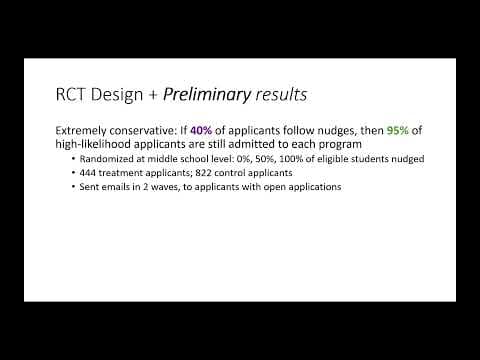
Recommendation in Equilibrium for the NYC High School Match (SIMONS-ECON)
This talk presents an informational intervention designed and deployed in collaboration with NYC Public Schools, aiming to mitigate disparities in the complex high school match process.
Automating the US Welfare State: Historical Experiments in Technological Federalism (SIMONS-ECON)
This lecture examines historical experiments in technological federalism, tracing the automation of the US welfare state and its implications for social policy and administration.
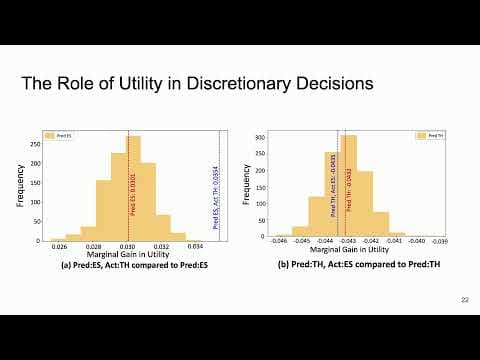
On Machine Learning for Prediction and Prioritization in the Allocation of Scarce Societal Resources (SIMONS-ECON)
This presentation discusses applying machine learning for predicting and prioritizing the allocation of scarce societal resources, drawing on theories of local justice and street-level bureaucracy.