Comparative Mythology, Folklore & History of Religion: From Ancient Near East to Early Christianity
This study path traces the development of religious and mythological traditions from their ancient Near Eastern roots to the emergence of early Christianity. It progresses from foundational textual analysis and contextualization to the intricate interplay of pagan and monotheistic beliefs, culminating in the transformation of religious identity within the Graeco-Roman world.
Explore the evolution of religious thought, mythological narratives, and ritual practices across diverse ancient cultures.
6steps5htotal runtime
Step 1 of 6
Path progress0 of 6 watched
Curriculum sequence
6
The Parts of the Whole
This lecture provides a foundational understanding of the Hebrew Bible's structure, essential for contextualizing subsequent discussions on ancient Israelite religion and its broader mythological landscape.
The Hebrew Bible in Its Ancient Near Eastern Setting: Biblical Religion in Context
Building on the textual foundation, this lecture situates Israelite religion within the Ancient Near East, critically comparing its monotheistic claims with surrounding pagan polytheism, thus establishing a comparative framework.

Step 3·Gresham College·Ronald Hutton· 49:12

Bridget: Goddess and Saint
Transitioning from monotheistic contexts, this lecture introduces the complex evolution of a Celtic goddess into a Christian saint, illustrating the syncretic processes central to comparative mythology and religious history.
Step 4·Gresham College·Ronald Hutton· 53:08
The Morrigan: The Nightmare Queen
Following the exploration of syncretism, this lecture delves into the multifaceted interpretations of another prominent Celtic mythological figure, further demonstrating the dynamic and often contradictory nature of religious narratives.
The Christian Roman Empire
This lecture shifts focus to the Christianization of the Roman Empire, examining the political and theological disputes that shaped early Christian identity and its interaction with existing pagan traditions.
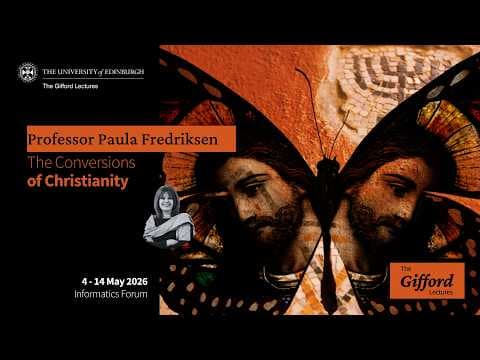

Israel Abroad: Jews Among the Gods
Finally, this lecture explores the diverse expressions of ancient Jewish identity within the Graeco-Roman world, providing crucial context for understanding the foundational developments of early Christianity amidst a pluralistic religious environment.
Companion reading for this sequence
2Amazon Associate

Lecturer's Course TextYale University Press · 1st Edition (2012)
Introduction to the Bible
By Christine Hayes
Written directly by Christine Hayes as the companion volume to her Yale RLST 145 Hebrew Bible course.
Written by Christine Hayes for RLST 145 · Matches 2 steps in pathISBN 978-0300181791
View on Amazon
Lecturer's Course TextYale University Press · 1st Edition (2018)
When Christians Were Jews: The First Generation
By Paula Fredriksen
Gifford Lecturer Paula Fredriksen's reconstruction of the earliest Jerusalem community within Second Temple Jewish apocalypticism.
Written by Paula Fredriksen for GIFFORDISBN 978-0300248401
View on Amazon