Electromagnetism, Waves & Optics: From Classical Fields to Quantum Light
This study path begins with the classical foundations of oscillations and the wave-particle duality of light, progressing to the relativistic framework of electromagnetism. It culminates in an introduction to Quantum Electrodynamics, bridging classical field theory with the quantum realm.
Explore the unified theory of electromagnetism, the mechanics of waves, and the quantum nature of light.
6steps6htotal runtime
Step 1 of 6
Path progress0 of 6 watched
Curriculum sequence
6
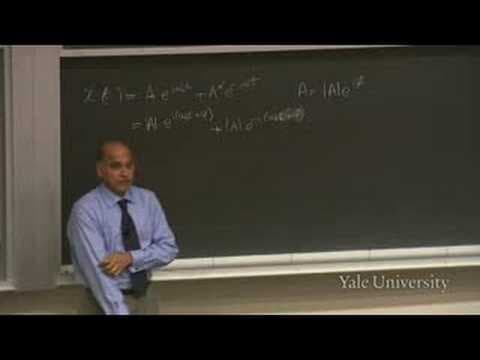
Simple Harmonic Motion
This lecture establishes the fundamental principles of oscillations and periodic motion, which are essential for understanding wave phenomena in electromagnetism and optics.

Wave-Particle Duality of Light
Building on the concept of oscillations, this lecture introduces the wave properties of light and the foundational idea of wave-particle duality, crucial for understanding light's behavior.
Introduction to Relativity
This lecture connects classical electromagnetism (Maxwell's theory) with special relativity, demonstrating how the principles of light propagation necessitate a relativistic framework.

Important Trends in AI: How Did We Get Here, What Can We Do Now, and Where Are We Headed?
Moving from classical waves to quantum optics, this lecture introduces Mach-Zehnder interferometers and beam splitters, illustrating quantum superposition and interference phenomena.
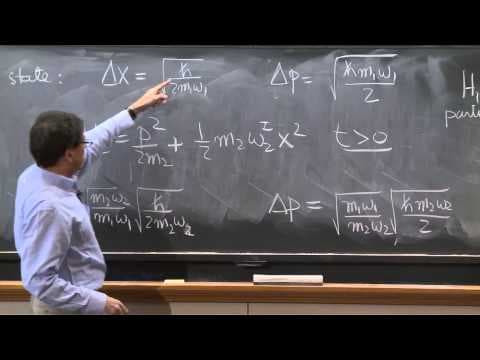
Quantum Dynamics III: Squeezed Vacuum States & Uncertainty Evolution
This lecture delves into advanced quantum states like squeezed vacuum states, building on the previous understanding of quantum optics and preparing for more complex quantum field theories.

Step 6·Caltech·Richard Feynman· 1:17:58

Quantum Electrodynamics: The Strange Theory of Light and Matter, Part 1
This final lecture introduces the foundational concepts of Quantum Electrodynamics, unifying electromagnetism with quantum mechanics and providing a glimpse into advanced theoretical physics.
Companion reading for this sequence
2Amazon Associate

Lecturer's Course TextYale University Press · Expanded Edition (2019)
Fundamentals of Physics I: Mechanics, Relativity, and Thermodynamics
By R. Shankar
Written directly from R. Shankar's beloved Yale PHYS 200 lectures, preserving his rigorous derivations and famously dry classroom wit.
Written by Ramamurti Shankar for PHYS 200 · Matches 2 steps in pathISBN 978-0300243772
View on Amazon
Lecturer's Course TextMIT Press · 1st Edition (2022)
Mastering Quantum Mechanics: Essentials, Theory, and Applications
By Barton Zwiebach
Written directly by MIT physicist Barton Zwiebach from his decade teaching the complete MIT 8.04, 8.05, and 8.06 Quantum Physics sequence.
Written by Barton Zwiebach for 8.05 · Matches 2 steps in pathISBN 978-0262046138
View on Amazon