Linguistics, Philology & Historical Decipherment: From Syntax to Decipherment
This study path begins with the foundational principles of theoretical linguistics, examining the structure and acquisition of human language. It then progresses to the historical evolution of languages and the techniques used to reconstruct and revitalize them, culminating in advanced discussions on decipherment and interspecies communication.
Explore the scientific study of language, its evolution, and the methods for deciphering ancient scripts and animal communication.
6steps8htotal runtime
Step 1 of 6
Path progress0 of 6 watched
Curriculum sequence
6
How Do We Communicate?: Language in the Brain, Mouth
This lecture provides a foundational introduction to the scientific study of language, covering core concepts like phonology, morphology, and syntax, essential for understanding subsequent topics.
Step 2·MIT·Noam Chomsky· 1:39:32

Language, Generative Grammar, and the Cognitive Revolution (Killian Lecture)
Building on the introduction to language structure, this lecture delves deeper into generative grammar and the cognitive revolution, exploring the philosophical underpinnings of language acquisition.
Historical Linguistics
Following an understanding of language structure and acquisition, this lecture introduces historical linguistics, explaining how languages evolve and diverge over time through various mechanisms.
Endangered Languages
Expanding on historical linguistics, this step focuses on practical applications, detailing efforts to revitalize endangered languages and reconstruct extinct grammars using historical documentation.

Step 5·MIT·Noam Chomsky & Bernie Sanders· 2:08:11
Bernie Sanders and Noam Chomsky: Deciphering Foreign Policy Jargon
Moving beyond language structure and evolution, this lecture applies linguistic analysis to real-world discourse, examining rhetorical strategies and power dynamics in political language.
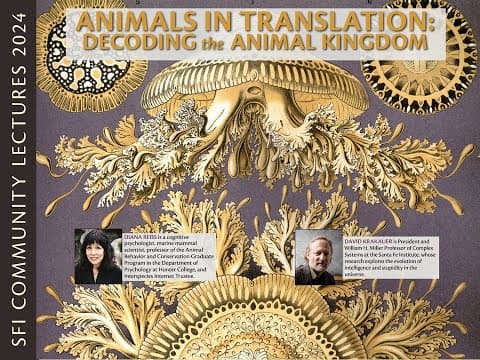

Animals in Translation: A Conversation
As a capstone, this lecture extends the principles of decipherment and communication analysis to interspecies communication, exploring criteria for decoding animal communication systems.
Companion reading for this sequence
2Amazon Associate

By the LecturerMIT Press · 50th Anniversary Edition (2015)
Aspects of the Theory of Syntax
By Noam Chomsky
MIT Institute Professor Noam Chomsky's foundational treatise establishing deep structure, transformational syntax, and the cognitive revolution in linguistics.
Book by Noam Chomsky featured in this lecture · Matches 3 steps in pathISBN 978-0262527408
View on Amazon
Lecturer's Course TextEcco / HarperCollins · 1st Edition (2023)
Psych: The Story of the Human Mind
By Paul Bloom
Written directly from Paul Bloom's celebrated Yale PSYC 110 Introduction to Psychology lectures—spanning perception, memory, language, and developmental cognition.
Written by Paul Bloom for PSYC 110ISBN 978-0063096363
View on Amazon