Mechanistic Interpretability, Alignment & World Models
This path explores the internal workings of AI, progressing from foundational concepts of neural network training and interpretability to advanced topics in AI alignment and world models. It culminates in discussions on scalable oversight and governance, bridging technical understanding with societal impact.
From neural circuits to scalable oversight: understanding and controlling advanced AI systems.
6steps5htotal runtime
Step 1 of 6
Path progress0 of 6 watched
Curriculum sequence
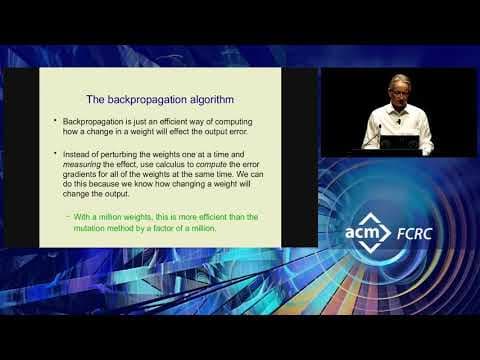
6Step 1·Association for Computing Machinery (ACM)·Geoffrey Hinton· 32:28

The Deep Learning Revolution (Turing Award Lecture)
This foundational lecture provides the historical context and conceptual genesis of deep learning, setting the stage for understanding the complex systems we aim to interpret and align.
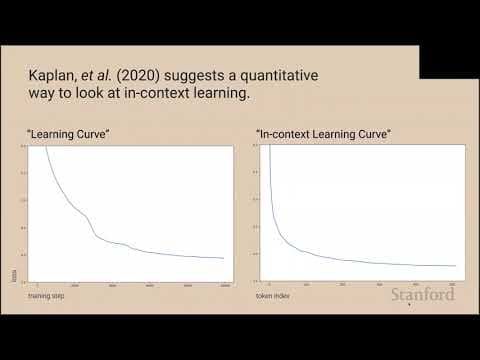

Transformer Circuits, Induction Heads, In-Context Learning
Building on the deep learning revolution, this lecture introduces mechanistic interpretability by dissecting transformer circuits, specifically induction heads, to understand how models achieve in-context learning.
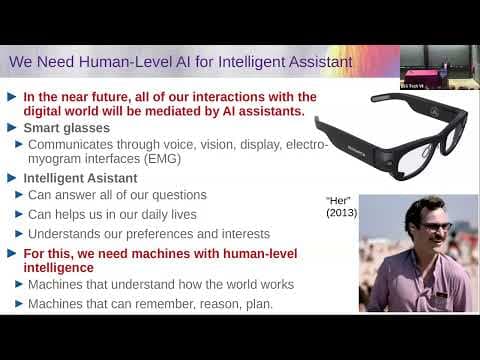
Step 3·Harvard University·Yann LeCun· 1:16:53

Objective-Driven AI: World Models that Learn, Remember, Reason, and Plan
Expanding beyond token prediction, this step introduces objective-driven AI and world models, offering a framework for how AI systems learn, remember, reason, and plan, which is crucial for alignment.
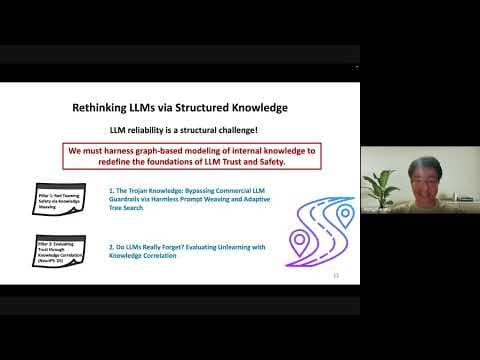
Step 4·Google Research & TechTalks·Rongzhe Wei· 56:22

Atomic Facts to Structured Knowledge: Rethinking Unlearning & Jailbreaking in Large Language Models
With an understanding of world models, this lecture delves into structured internal knowledge modeling, which is essential for addressing unlearning and jailbreaking, directly impacting AI safety and alignment.

AI and Safety
This lecture directly addresses critical aspects of AI safety, exploring methods and theoretical frameworks to ensure robust and reliable operation, building upon the technical insights from interpretability and world models.
Step 6·UC Berkeley·Inioluwa Deborah Raji· 39:55
Governance at the Technological Frontier: Translating AI Research into Oversight Policy
The final step translates technical AI safety research into practical oversight policy, examining the institutional and regulatory mechanisms needed to govern advanced AI systems effectively.
Companion reading for this sequence
2Amazon Associate

By the LecturerMIT Press · 1st Edition (2016)
Deep Learning
By Ian Goodfellow, Yoshua Bengio, Aaron Courville
Co-authored by Turing Laureate Yoshua Bengio—the foundational MIT Press reference on representation learning, optimization, and convolutional architectures.
Book by Geoffrey Hinton featured in this lecture · Matches 2 steps in pathISBN 978-0262035613
View on Amazon
Course TextbookManning Publications · 1st Edition (2024)
Build a Large Language Model (From Scratch)
By Sebastian Raschka
Step-by-step architectural guide to implementing tokenization, multi-head self-attention, pretraining, and alignment from first principles.
Assigned syllabus text for CS25ISBN 978-1633437166
View on Amazon